Custom Metal & Enamel Keychains: The Complete B2B Sourcing and Manufacturing
Executive Summary
Custom metal and enamel keychains represent one of the highest-retention promotional products and retail merchandise categories in the fashion, automotive, corporate branding, and collectible industries. Unlike lapel pins or display emblems that remain relatively static when worn or showcased, keychains endure continuous mechanical stress, daily pocket abrasion, friction against vehicle keys, and exposure to varying atmospheric conditions.
For corporate procurement managers, brand founders, and promotional merchandise distributors, specifying a custom keychain order requires a technical understanding of base metals, molding methods, coloring chemistries, surface protection, and hardware engineering. Selecting an inappropriate enamel finish or plating standard can lead to premature surface scratching, enamel chipping, or hardware failure—directly impacting brand perception.
This technical white paper outlines the complete engineering and sourcing lifecycle for custom metal and enamel keychains. It provides actionable criteria for choosing between soft enamel, hard enamel, and die-cast zinc alloy, evaluating electroplating durability, selecting heavy-duty attachment hardware, and establishing quality control standards before placing commercial bulk orders.
1. Why Keychains Demand Higher Durability Standards than Lapel Pins
While custom enamel lapel pins and custom metal keychains share foundational manufacturing techniques—such as precision tooling, color filling, and electroplating—their functional environments are entirely different.
A metal pin pinned to a suit lapel, backpack, or banner experiences minimal physical friction. In contrast, a daily-use keychain encounters:
- Dynamic Surface Abrasion: Repeated contact with hardened steel keys, coins, and interior pocket linings.
- Impact Shock: Frequent drops onto asphalt, table surfaces, and vehicle consoles.
- Torsional & Tensile Hardware Stress: Continual twisting and pulling forces exerted on the junction loop and jump rings during daily handling.
- Moisture & Skin Oil Exposure: Continuous contact with human sweat, atmospheric humidity, and rain, accelerating potential oxidation or tarnish on sub-standard plating.
Because of these demanding conditions, production artwork cannot simply be duplicated from a pin mold to a keychain mold without considering structural thickness, border wall reinforcement, attachment loop gauge, and surface protective layers.
2. Enamel Processes Compared: Soft Enamel vs. Hard Enamel for Keychains
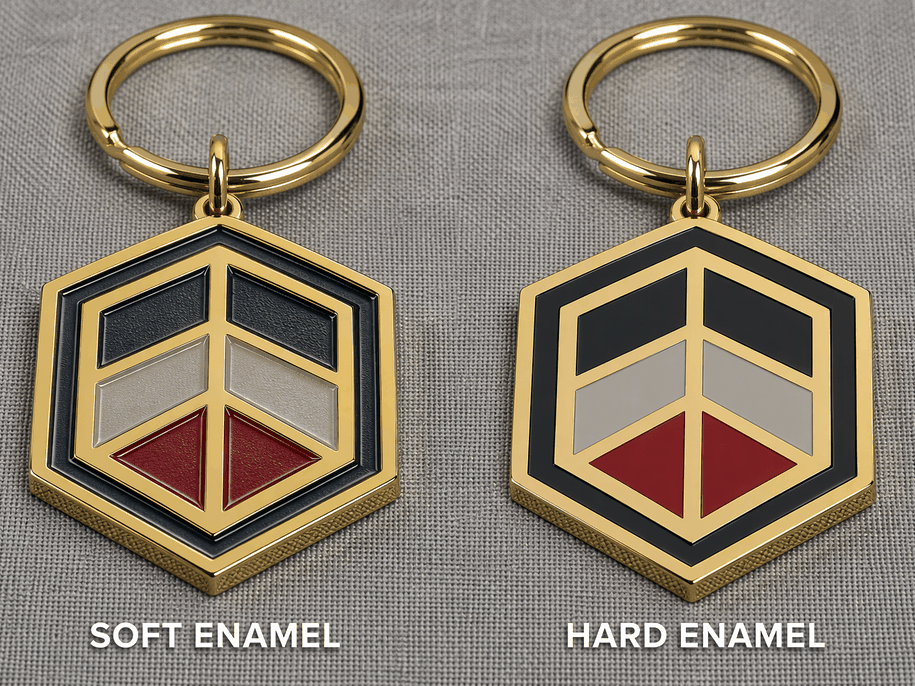
Choosing the correct coloring technique is the primary aesthetic and functional decision in custom keychain manufacturing. The two industry-standard methods—soft enamel and hard enamel—behave differently under constant abrasion.
| Feature / Metric | Soft Enamel Keychains | Hard Enamel Keychains |
| Surface Texture | Recessed color areas with raised rims | Completely flat, polished, glass-like |
| Visual Depth | Distinct 3D dimensional tactile feel | High-end jewelry and automotive sheen |
| Scratch Resistance | Moderate (High when epoxy is added) | Superior intrinsic hardness |
| Color Fine Details | Accommodates finer line divisions | Requires minimum 0.3mm metal walls |
| Relative Unit Cost | Cost-effective for mid-to-large runs | Higher due to manual stone polishing |
| Ideal Applications | Streetwear, events, clubs, giveaways | Automotive brands, luxury, retail VIP |
Soft Enamel Keychains: Dimensionality and Cost Efficiency
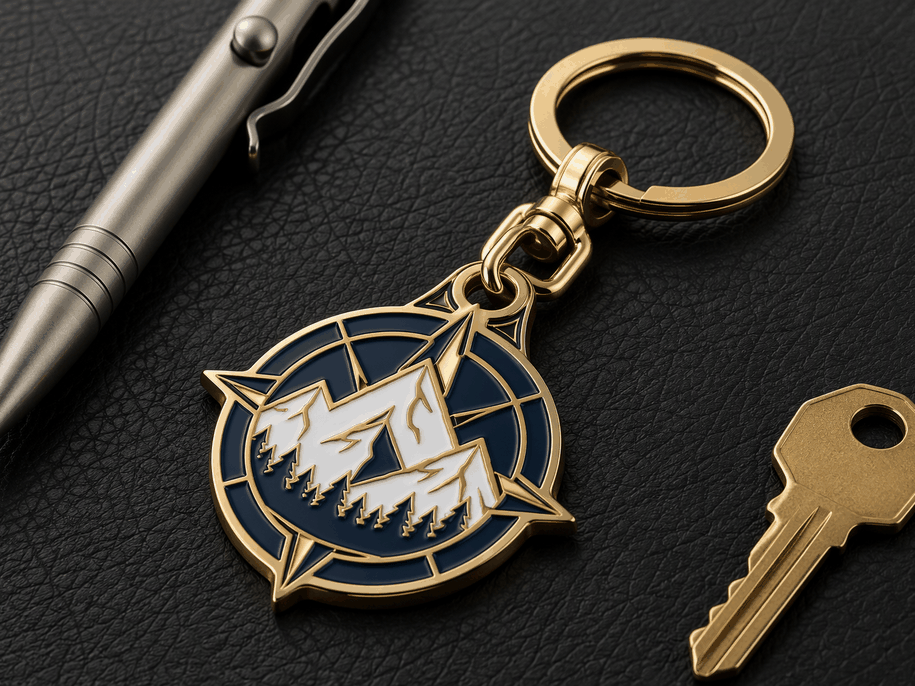
In soft enamel manufacturing, liquid pigment is dispensed into the recessed cavities of the stamped or die-cast metal base, leaving the metal borders raised. The enamel is baked at moderate temperatures (approximately 160°C to 200°C).
- The Durability Factor: Because the enamel sits below the raised metal edges, the metal walls absorb the brunt of flat surface impacts. However, deep keys can scratch into the recessed color pockets over time.
- The Epoxy Advantage: To create maximum scratch resistance for everyday carry (EDC), a transparent, dome-shaped epoxy resin coating can be cured over the soft enamel surface. This hermetically seals the pigment, creating a smooth, scratch-resistant barrier that protects against dirt and moisture.
Hard Enamel Keychains: Premium Flat Polish & Lifetime Durability
Hard enamel (often referred to as imitation cloisonné) is the gold standard for executive gifts, automotive dealerships, and upscale retail collections.
- The Manufacturing Process: Powdered paste enamel is filled into the cavities, baked at high temperatures (over 800°C in traditional cloisonné, or approximately 220°C–250°C for modern poly-hard enamels), and then ground down with abrasive stones until the enamel and metal separating walls sit on the exact same plane.
- Surface Performance: The resulting surface is completely flat, lustrous, and exceptionally resilient. Hard enamel will not fade, soften, or peel over decades of normal use. It offers built-in resistance to scratches and requires no secondary epoxy dome.
3. Base Metal Selection and Forming Methods
The structural integrity of a metal keychain begins with the metallurgical base. Sourcing managers must evaluate weight, casting detail, and mechanical shear strength when selecting alloys.
Die-Cast Zinc Alloy (Recommended for Keychains)
Zinc alloy is injected under high pressure into steel molds at molten temperatures (~420°C).
- Dimensional Versatility: Outstanding fluidity allows for intricate 3D sculpting, curved organic surfaces, bas-relief textures, and full through-hole cutouts (skeleton designs).
- Weight & Hand Feel: Provides a substantial, weighty, premium tactile feel in the customer's hand without being overly brittle.
- Integrated Attachment Loops: Attachment loops can be cast directly into the perimeter as a single solid piece, eliminating weak welded solder joints.
Die-Struck Brass/Bronze
High-tonnage hydraulic presses stamp the artwork into solid brass sheets.
- Sharp Line Definition: Brass allows for the sharpest, crispest typographic detailing and straight micro-borders.
- Application: Ideal for 2D hard enamel emblems where extreme edge precision is prioritized over 3D curvature.
Stamped Iron
Iron is stamped using high pressure and plated to mimic brass or zinc.
- Economics: The most economical base metal for high-volume, cost-constrained promotional giveaways.
- Limitations: Prone to rust if the electroplating is chipped or scratched through to the core; cannot achieve complex 3D contoured reliefs.
4. Electroplating Metallurgy: Corrosion Resistance & Compliance
Because keychains are frequently handled, the electroplating layer must resist both mechanical friction and chemical tarnishing caused by skin oils and ambient moisture.
Commercial Plating Options
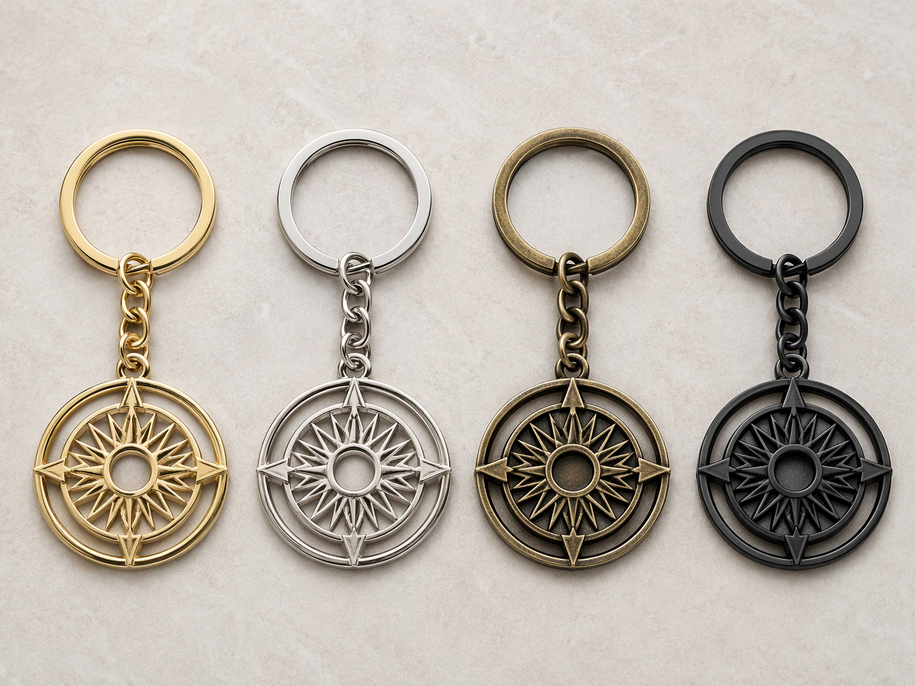
- Shiny Finishes (High Polish): Gold, Nickel (Silver), Chrome, Rose Gold, and Black Nickel.
- Antique / Vintage Finishes: Antique Bronze, Antique Silver, Antique Copper. Antique finishes utilize a dark recessed wash that accentuates recessed 3D detailing, masking minor scratches that develop over years of daily pocket use.
- Dual-Tone Plating: Utilizing selective masking to plate specific design areas in gold while leaving surrounding frames in silver/nickel, creating distinct visual contrast.
Environmental & Safety Compliance (EU/US Standards)
International buyers must guarantee regulatory compliance for consumer goods:
- Nickel-Free Electroplating: Essential for European (REACH Annex XVII) and North American markets to prevent allergic contact dermatitis.
- Lead & Phthalate Restrictions: Metal cores and any rubber or PVC hybrid components must comply with US CPSIA guidelines (lead content < 90 ppm).
5. Attachment Hardware Engineering & Mechanical Reliability
A custom keychain is only as dependable as its weakest hardware component. The primary point of field failure in low-grade keychains is the connecting jump ring or lower swivel joint. To ensure commercial durability, the entire assembly must be engineered as an interconnected load-bearing system:
Structural Hardware Flow:
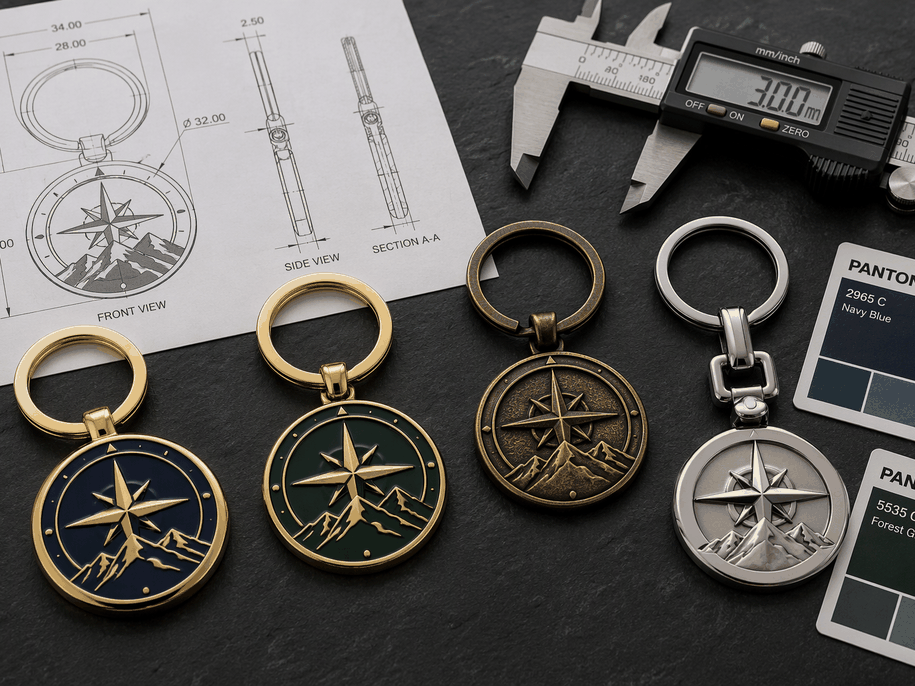
Main Metal Emblem ➔ Reinforced Molded Eyelet (≥ 2.0mm) ➔ Heavy-Gauge Jump Ring/Welded O-Ring ➔ 360°
Swivel Connector ➔ Final Keyring Attachment
The 5 Critical Hardware Assembly Tiers:
- Tier 1: Main Metal Body (Die-Cast/Stamped)
The core branding component, precision-cast from zinc alloy or stamped brass with balanced weight distribution to prevent excessive rotational drag on key ignitions. - Tier 2: Integrated Molded Eyelet (Wall Thickness: ≥ 2.0mm)
Rather than welding a separate loop after casting, the eyelet is cast directly as a continuous part of the emblem. A minimum wall thickness of 1.8mm to 2.2mm prevents tear-out failure during aggressive pocket extraction. - Tier 3: Heavy-Gauge Connecting Jump Ring (≥ 1.5mm Wire Gauge)
Standard open rings easily pull apart when caught. Industrial-grade keychains utilize heavy-duty tempered steel jump rings, tightly machine-crimped or laser-welded into a permanent closed loop. - Tier 4: 360° Swivel Link / Multi-Link Chain
Incorporating a smooth-action 360° swivel link allows the emblem to rotate independently of the keyring, eliminating torsional fatigue and preventing keys from bunching together in pockets. - Tier 5: Final Attachment Hardware
- Flat Split Keyring (28mm–32mm): Modern, premium low-profile design that holds multiple vehicle keys without deforming.
- Heavy-Duty Swivel Lobster Clasp: Ideal for clipping directly onto backpacks, belt loops, or purse straps.
- Carabiner & Functional Utility Clips: Excellent for outdoor, tactical, and workwear merchandise.
Multi-Functional Utility Enhancements
To maximize customer retention and daily usability, custom metal keychains can also incorporate secondary functional features directly into the mold tooling:
- Integrated Bottle Opener: Recessed underside hook or inner cutout engineered to open crown bottle caps without damaging the enamel face.
- Trolley Coin / Shopping Token: Precision-dimensioned detachable or molded token matching standard European (1€/2€) or US coin specifications.
- Dual-Sided Spinner: An inner enamel core mounted on an axle bearing that spins inside an outer metal chassis, creating a high-tactile fidget item.
6. Sourcing Comparison Matrix: Metal vs. Embroidered vs. PVC Keychains
GreenHouse (mcpatch) provides comprehensive manufacturing capabilities across all modern badge and keychain mediums. Sourcing managers should select the medium that aligns with their target application:
| Keychain Medium | Primary Material | Tactile Feel | Durability in Pocket | Key Aesthetic Advantage | Best-Fit Industry / Use Case |
| Custom Enamel/ Metal | Zinc Alloy/Brass | Solid, heavy, cool to touch | Exceptional (10+ years) | Executive jewelry finish, rich metallic luster | Automotive, Real Estate, Corporate VIP, Retail Brands |
| Custom Embroidered | Polyester Thread/Twill | Flexible, fabric texture | High tear strength, non-scratch | vintage aviation jet tag & fight ribbon style | Aviation, Motorcycle Clubs, Streetwear, Casual Bags |
| Custom 2D/3D PVC | Eco-friendly Soft PVC | Flexible, rubbery, waterproof | Shockproof, bendable | Vibrant Pantone colors, bold 3D relief, lightweight | Outdoor Gear, Youth Brands, Sports Clubs, Gaming Merch |
| Custom Woven | Ultra-fine Woven Yarn | Slim, flat, dense fabric | High abrasion resistance | High-definition text & micro-logos without distortion | Apparel Labels, Tech Accessories, Minimalist EDC |
7. Step-by-Step B2B Procurement & Quality Control Protocol
To ensure seamless production from digital vectors to mass delivery, commercial buyers should follow this standardized procurement pipeline:
Step 1: Production Artwork Preparation
- Vector artwork must be submitted in
.AI,.EPS, or vector.PDFformats. - Line weights for raised metal walls should not fall below 0.2mm for soft enamel or 0.3mm for hard enamel.
- Colors must be specified in the Pantone Formula Guide Solid Coated (PMS) system to eliminate color discrepancies between screen and physical dye.
Step 2: Tooling and Pre-Production Sample Approval
- A precision CNC steel mold is cut from the approved 2D/3D engineering proof.
- Physical pre-production samples (typically completed within 3 to 5 business days) allow buyers to physically inspect weight, plating tone, enamel level, and swivel operation before authorizing the full production run.
Step 3: Mass Production Quality Standards (AQL 0.65/1.5)
Professional manufacturers inspect keychains against strict acceptance criteria:
- Surface Integrity: No visible bubbling, pinholes, color bleeding, or metal burrs under 10x visual inspection.
- Adhesion & Plating Test: Cross-hatch tape adhesion tests and 24-to-48-hour salt spray corrosion testing to verify electroplating stability.
- Tensile Testing: Attachment assembly must withstand a minimum pull-force of 5 kg to 10 kg without ring deformation.
Step 4: Packaging and Retail Presentation
Bulk orders should be protected with individual polybags to prevent metal-on-metal transit scratching. Optional high-perceived-value packaging includes:
- Custom printed backing cards (350gsm cardstock with foil stamping).
- EVA foam-lined magnetic presentation gift boxes for corporate presentations.
Frequently Asked Questions (FAQ)
Q1: What is the minimum thickness recommended for custom metal keychains?
For most two-sided or single-sided metal keychains between 1.5 and 2.5 inches in diameter, a finished thickness of 3.0mm to 3.5mm is strongly recommended. A thickness under 2.0mm can feel flimsy and is susceptible to eyelet warping under heavy tension, whereas 3.0mm+ delivers a luxury weight and allows for deep 3D relief on both faces.
Q2: Can soft enamel keychains be protected without losing their 3D texture?
Yes. If buyers appreciate the recessed tactile texture of soft enamel but require enhanced resistance to dirty pocket conditions, manufacturers can apply a thin conformal liquid clear coat or specify durable baked synthetic enamel instead of a full domed epoxy layer.
Q3: Can a custom metal keychain feature two different designs on the front and back?
Yes. Die-cast zinc alloy molds can be cut with completely distinct tooling on both Side A and Side B. For example, Side A can feature a multi-color hard enamel corporate emblem, while Side B displays deep 3D engraved commemorative lettering, a textured recessed sandblast pattern, or an integrated bottle opener notch.
Q4: How long does a mass production run take for custom enamel keychains?
Standard manufacturing lead time at Shenzhen Gelinjia Technology (mcpatch) is typically 12 to 15 business days following pre-production sample sign-off. Express fast-track production can be completed in as little as 7 to 10 business days for urgent event deadlines, with flexible minimum order quantities starting from 50 to 100 units.
Conclusion & Factory Direct Collaboration
Custom metal and enamel keychains provide unmatched durability, high perceived brand value, and continuous brand impressions over years of daily utility. Success in sourcing bulk keychains relies on partnering with an integrated manufacturer capable of executing precision mold fabrication, in-house plating control, and stringent mechanical quality assurance.
As an established OEM/ODM manufacturer with over a decade of specialized expertise, Shenzhen Gelinjia Technology (GreenHouse/mcpatch) operates fully integrated production facilities—spanning precision CNC mold tooling, in-house electroplating, computerized color dispensing, and rigorous AQL quality inspection. Whether your project calls for 50 pieces for an exclusive club launch or 50,000 units for global corporate distribution, our engineering team ensures your custom metal keychains withstand the test of time.
Related Article