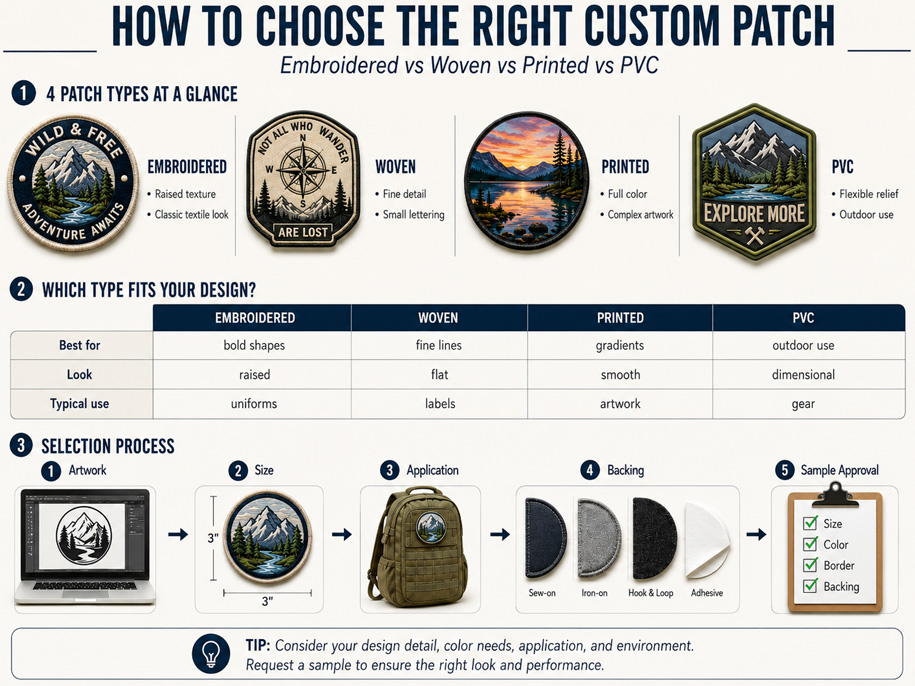
What Makes a PVC Patch Ready for Outdoor Use?

Executive Summary
Outdoor patches are expected to do more than look good in a product photograph. A patch on a backpack, work jacket, tactical pouch or event uniform may face rain, dust, sunlight, repeated flexing and constant contact with other surfaces. Those conditions make soft PVC an attractive option: it can reproduce raised and recessed shapes, it does not absorb water like a textile surface, and it can be wiped clean. Yet the material name alone does not prove that a finished patch is ready for outdoor service.
For buyers comparing PVC patches for outdoor gear, the better question is not simply, “Is PVC waterproof?” It is, “Has this particular patch been designed and evaluated for the way it will actually be used?” The answer depends on the compound, geometry, color system, attachment method and test conditions. This white paper explains the decisions that matter before an outdoor patch goes into production.
1 Outdoor use is a set of conditions, not a single claim
“Outdoor” can describe very different applications. A removable morale patch on a weekend backpack does not experience the same stress as an identification patch worn daily by a field crew. A promotional badge used for a summer event may need good short-term color appearance, while a patch on equipment stored in a vehicle may face repeated heating and cooling.
Before requesting a quotation, the buyer should define the intended environment:
• Where will the patch be used: on clothing, bags, equipment or another surface?
• Will it be exposed occasionally or remain outdoors for long periods?
• Is it likely to encounter rain, sweat, mud, salt spray, oils or cleaning agents?
• Will it rub against straps, tools, seats or other gear?
• Does the patch need to bend with fabric, or remain relatively firm?
• Is removal required, or should the attachment be permanent?
These answers create a useful performance brief. Without them, phrases such as “weather resistant PVC patches” remain too broad to guide production or quality control.

2 Water resistance involves more than the face of the patch
Soft PVC has a non-textile surface that can be easier to clean after contact with water or mud. That benefit is valuable for outdoor garments and equipment. However, it should not be turned into an unsupported promise that every finished patch is completely waterproof.
Water may affect more than the molded front. The complete assembly can include a hook-and-loop layer, adhesive, fabric, stitching channels or a heat-applied interface. Moisture may also reach the garment through the needle holes around a sewn patch. The performance of the full assembly therefore depends on both the patch and the way it is attached.
Buyers should state whether they need splash resistance, routine washing, temporary immersion or another defined condition. The sample can then be evaluated under that condition and inspected for lifting, warping, color change, surface damage and attachment failure. A meaningful water-resistance claim should always identify what was tested, for how long and under what conditions.
3 Geometry influences wear and cleanability
PVC patches can be produced with flat color areas, raised outlines and multi-level details. These effects give a logo depth, but the deepest or smallest features are not automatically the most practical for field use.
A 2D construction uses clear height changes between major areas and is often effective for lettering, borders and bold emblems. A 3D construction uses rounded or sculpted relief to create volume. It can produce a strong visual effect for mascots, symbols and product branding, but very shallow transitions may be less distinct at normal viewing distance.
For an outdoor application, the designer should also consider cleaning. Narrow recessed channels can collect fine dirt. Tall, thin projections are more exposed to repeated contact. Very small raised lettering may lose visual clarity once the patch is dusty or viewed from several feet away. In many cases, broader shapes, sufficient spacing and deliberate relief produce a better working patch than maximum detail.
The right test is simple: review the artwork at final size, not only as an enlarged screen image. Then inspect a physical sample under ordinary light and from the distance at which the patch will normally be seen.

4 Flexibility must suit the item carrying the patch
A patch for a curved cap panel or flexible jacket needs to move differently from a label mounted on a structured case. Material hardness, patch thickness, overall size and relief depth all affect the way the finished piece bends.
Material hardness can be compared during development, but a number is useful only when linked to the intended application. In practical sourcing terms, two patches should not be judged by hardness alone. Thickness, shape, relief depth and overall construction must be considered together. A patch that feels suitable as a small bag label may become too rigid when enlarged, while an extremely flexible construction may not hold deep sculpted details as intended.
A pre-production sample should be attached to the actual fabric or a representative panel. Bend and flex the assembly repeatedly, paying attention to the corners, narrow sections and connection between the PVC body and its backing. The goal is not to create an impressive laboratory claim; it is to identify whether the approved construction behaves correctly on the final product.
5 Sunlight and color require a defined expectation
Bright colors are one reason brands choose molded PVC. Outdoor exposure, however, introduces ultraviolet radiation, heat and moisture, all of which can change the appearance or physical properties of plastics over time. The result depends on the material formulation, pigments, exposure direction, climate and duration.
That is why “UV resistant” should never be treated as a universal feature without supporting conditions and results. For projects in which long-term outdoor appearance is important, the buyer and supplier should agree on an exposure requirement and an acceptable level of change.
For an individual project, the approval team can compare a production sample with an unexposed control sample after a defined period of outdoor or controlled-light exposure. The record should identify the location or light source, exposure time, temperature range and the way color change is judged. This does not create a universal lifetime claim, but it gives the buyer relevant evidence for the planned application. A longer natural outdoor trial may also be useful when appearance in a particular climate is important.
Color approval deserves the same discipline. Colors displayed on a screen are not reliable production references because monitors, software and lighting conditions differ. Buyers should identify critical brand colors, review a physical color reference where possible and approve the molded sample under controlled lighting. For repeat orders, keeping the approved sample as a control helps both parties judge later production consistently.
6 Abrasion is often the real outdoor problem
Rain receives most of the attention, but surface contact may cause more visible damage in daily use. A patch on a bag can rub against clothing, vehicle interiors, webbing and the ground. Raised areas and outer borders usually receive contact first.
An abrasion check should reflect the intended product. The team can compare an unused control sample with a test sample after a defined number of rubbing cycles using a stated contact material and load. Inspection should cover gloss change, loss of fine texture, damage to raised edges, transfer of color and reduced legibility. A test without recorded conditions produces an anecdote, not reusable quality evidence.
There is no single cycle count that suits every patch and every market. The acceptance criterion should come from the risk of the application. A fashion accessory and a patch for frequently handled work equipment may reasonably require different test plans.
7 Attachment should be evaluated as part of the product
Green House currently presents PVC options that include hook-and-loop, heat-applied and other custom constructions on its PVC patch product page. Each method answers a different need.
Hook-and-loop is useful when patches must be changed, removed before cleaning or reassigned between pieces of equipment. Its field performance depends on the mating material, coverage area, sewing quality and contamination by dirt or fibers. A sewn construction can provide a permanent mechanical connection, but the patch needs a suitable sewing channel and the garment must tolerate stitching. A heat-applied option depends on the compatibility of the patch, adhesive system, base fabric, temperature, pressure and application time.
The attachment should therefore be tested on the real substrate whenever possible. Testing the patch in isolation cannot reveal fabric distortion, edge lifting, weak engagement or damage caused by an unsuitable heat process.

8 A practical approval plan for professional buyers
An effective approval process can be short, provided that it is specific. Before mass production, the buyer should confirm the following:
1. Final-size artwork: Check lettering, spacing, relief levels and border width at the intended dimensions.
2. Application sample: Mount the patch on the actual garment, bag or representative material.
3. Visual reference: Approve physical color and retain a signed or dated control sample.
4. Flex check: Bend the mounted sample in the areas that will move during use.
5. Surface-wear check: Test the raised areas and border under defined rubbing conditions.
6. Moisture and cleaning check: Use the expected cleaning method and record time, temperature and cleaning agent.
7. Exposure requirement: If sunlight stability matters, agree on an exposure method, duration and acceptable level of color or surface change.
8. Attachment inspection: Look for lifting, separation, weak hook-and-loop engagement or damage to the base material.
For every test, record the specimen, procedure, duration, environment and pass/fail rule. Photographs taken before and after testing are especially useful. This turns product approval into traceable evidence and gives the supplier a clear basis for repeat production.
9 Frequently asked questions
9.1 Are all PVC patches waterproof
The molded PVC face does not absorb water in the same way as an embroidered surface, but the finished product includes edges, attachment components and a base item. Use a precise claim tied to a defined test instead of assuming that every construction is waterproof.
9.2 Are PVC patches suitable for backpacks and tactical gear
They can be well suited to these applications because the surface is easy to wipe and can carry bold raised or recessed graphics. The geometry, flexibility and attachment still need to match the specific bag or equipment.
9.3 Is 2D or 3D better for outdoor use
Neither is automatically better. 2D relief often supports clear lettering and simple identification, while 3D relief can add sculpted form. The correct choice depends on viewing distance, cleaning needs, expected abrasion and the artwork.
9.4 Can a PVC patch be machine washed
Washability must be confirmed for the complete patch-and-garment assembly. Detergent, water temperature, cycle action, drying method and attachment type can all affect the result. Removable patches may be taken off before washing if the product instructions allow it.
9.5 Will the colors fade in sunlight
Any outdoor material can change with sufficient exposure. The rate depends on formulation, pigment and environment. If color retention is critical, request an agreed exposure test and measurable acceptance criteria rather than a general verbal assurance.
10 The specification matters more than the label
A durable outdoor patch is the result of matching design and verification to a real use case. PVC offers useful advantages: molded relief, strong visual contrast, a cleanable surface and multiple attachment possibilities. Those advantages become dependable only when the buyer defines exposure, approves the physical sample and evaluates the whole assembly.
For Green House customers, the most productive starting point is a complete application brief: final artwork and size, base product, attachment preference, expected environment, cleaning method and required service period. With that information, the supplier can recommend a construction and create a sample that can be judged against clear requirements. That is a more reliable route to PVC patches for outdoor gear than relying on broad claims such as “waterproof,” “UV-proof” or “indestructible.”

Related Article