Inside a Custom Embroidered Patch: What Determines Quality?

Executive Summary
The quality of a custom embroidered patch cannot be judged by stitch count alone. It depends on how the artwork is digitized, how stitches are distributed, how much base fabric remains visible, how the edge is finished, and whether the backing suits the application. Adding more stitches cannot correct a poor construction plan.
Buyers should evaluate embroidered patch quality by comparing a physical sample with an approved specification at the actual production size. Lettering should remain legible, fills should appear even, outlines should register correctly, and the border and backing should suit the intended garment. This paper defines those checkpoints without relying on vague “premium quality” claims.
Quality Begins with Digitizing
An embroidery machine cannot interpret a logo like a printer. The artwork must be converted into a stitch file defining stitch types, directions, sequence, underlay and color changes. This is digitizing.
Good digitizing adapts the design to thread and fabric. Wide color areas may use fill stitches, while lettering and narrow elements require another suitable construction. Stitch direction also changes the way light reflects from the surface.
Poor digitizing can produce distorted lettering, gaps between fills and outlines, uneven curves, excess thread buildup or unnecessary stiffness. These defects often begin with a stitch plan that does not suit the artwork, material or finished size.
Green House has more than ten years of embroidery digitizing experience. The production question is whether a digital logo can become stable, readable embroidery at the requested dimensions-not whether it looks attractive on a large screen.

Stitch Density Is a Balance, Not a Maximum
Embroidered patch stitch density describes how closely stitches are arranged in a filled area. Both insufficient and excessive density can create quality problems.
If density is too low, base fabric may show through and fills may look inconsistent. If it is too high, thread can build up, small details can close and the patch may become rigid or distorted. The appropriate setting depends on:
- Thread type and thickness
- Base fabric and stabilizer
- Stitch type and direction
- Size of the embroidered area
- Overlapping design elements
- Desired texture and flexibility
There is therefore no meaningful universal density figure. It must be assessed within the complete stitch program and confirmed by sampling.
Embroidery Coverage Changes Appearance, Weight and Cost
Embroidery coverage is the proportion of the surface covered by stitching. Coverage describes how much area is embroidered; density describes how closely stitches are placed within that area.
Open areas can intentionally expose the twill or other base fabric, producing a lighter, more flexible patch. A fully embroidered surface creates a richer thread-led appearance but generally requires more machine time and may feel heavier.
Neither construction is automatically superior. Quality depends on whether coverage matches the approved artwork. Quotations should distinguish partial from extensive embroidery rather than treating equally sized patches as equivalent.
| Construction factor | What the buyer should inspect | Common warning sign |
| Digitizing | Letter shape, stitch direction and sequence | Distorted text or unnecessary thread buildup |
| Stitch density | Even fills without excessive stiffness | Visible gaps or crowded small details |
| Coverage | Agreement with the approved design | Unexpected base fabric or unplanned heavy stitching |
| Registration | Alignment between outlines and color areas | Gaps, overlaps or shifted outlines |
| Edge finish | Consistent shape and clean perimeter | Loose threads, uneven corners or exposed fabric |
| Backing | Suitability for the attachment method | Weak adhesion, excess bulk or incorrect orientation |

Borders Are Both Structural and Visual
The border defines the patch silhouette and controls the exposed base-material edge. Two common approaches are overlocked borders and heat-cut or laser-cut edges.
An overlocked, or merrowed-style, border creates a rounded thread edge. It works particularly well on circles, ovals, squares and simple shields, contributing to a traditional badge appearance.
Complex outlines and irregular silhouettes are usually better suited to heat-cut or laser-cut edges, which follow the shape closely and create a flatter perimeter. The method should be selected during artwork review because changing it can alter the visible dimensions.
A quality border should remain consistent, align with the embroidered design and avoid loose ends. Corners and tight curves require particular attention.
Backing Must Match the Final Application
Backing affects attachment, flexibility, thickness and how the patch behaves on a garment.
Plain backing supports permanent sewing. Heat-activated backing enables iron-on or heat-press application, but bonding depends on fabric, temperature, pressure and time. Hook-and-loop backing suits removable patches. Temporary adhesive can assist positioning but should not be assumed to provide permanent attachment.
Confirm the attachment method before production. A backing that performs well on one fabric may fail on another, while sensitive materials may not tolerate heat. Buyers should test the complete patch-and-garment combination.
A Practical Approval Process for Bulk Orders
Sample approval should create a reference for buyer and manufacturer. The record should include:
- Final artwork version and orientation
- Finished width and height
- Approved thread colors and base fabric
- Border construction
- Backing type and placement
- Packaging requirements
- Intended garment and care conditions
- Any agreed inspection or test method
Examine the sample under consistent light. Check spelling, small lettering, color registration, puckering, loose threads, edge consistency and shape. Compare measurements with the agreed tolerance rather than judging only by eye. Or washable applications, buyer and supplier may define a laundering procedure.

Frequently Asked Questions
Does a higher stitch count always mean better quality?
No. Stitch count reflects size, coverage, detail and construction. Excessive stitching can cause stiffness or obscure details. The correct stitch plan matters more than the highest count.
Why does small text sometimes look different from the artwork?
Thread and needles have physical limits. Narrow strokes, tight gaps and tiny letter counters may need enlargement or simplification at the final production size.
Should the base fabric ever be visible?
Yes, when partial coverage is intentional. Visible base fabric becomes a defect only when it differs from the approved construction or shows unintentionally through a fill.
Which border is better?
Neither is universally better. Overlocked borders suit regular shapes; heat-cut or laser-cut edges suit complex outlines. Shape and desired appearance determine the method.
Can an iron-on patch be used on every garment?
No. Fabric composition, surface treatment and heat sensitivity affect bonding. Test the complete application before bulk use.
Conclusion
Consistent embroidered patch quality comes from coordination, not one headline number. Digitizing translates the design; density affects fill and flexibility; coverage shapes appearance and production time; borders define the edge; and backing connects the patch to its final use.
For bulk buyers, the strongest assurance is a documented specification, approved physical sample and application-based inspection. Green House reviews artwork, construction and attachment requirements before production, while changes are still practical.

When Printing Works Better Than Thread
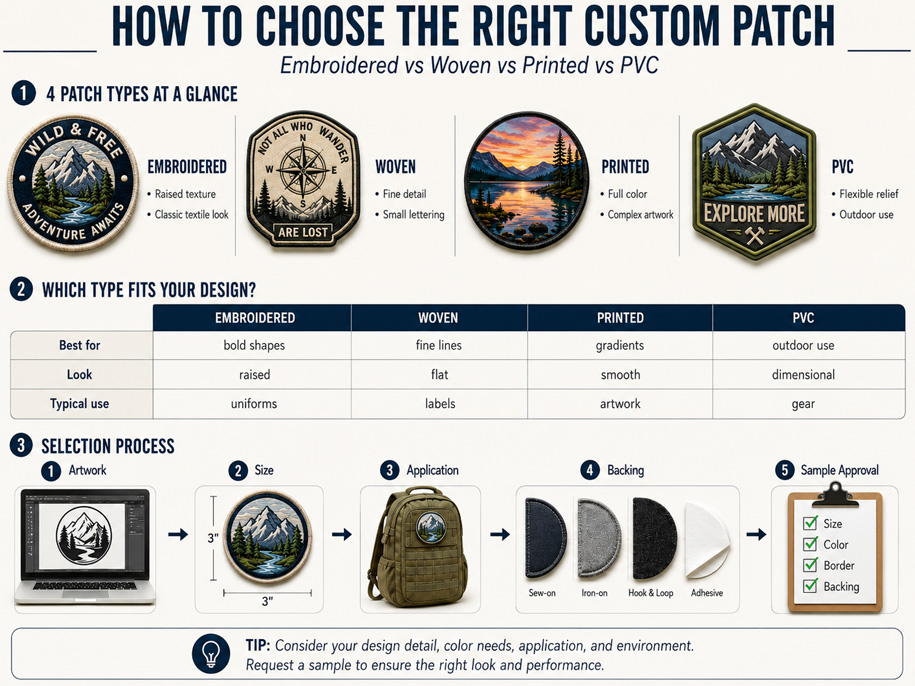
Custom Patch Selection: Embroidered vs Woven vs Printed vs PVC Patches
Related Article