Custom Patch Selection: Embroidered vs Woven vs Printed vs PVC Patches
Publication Date: August 2026
Executive Summary
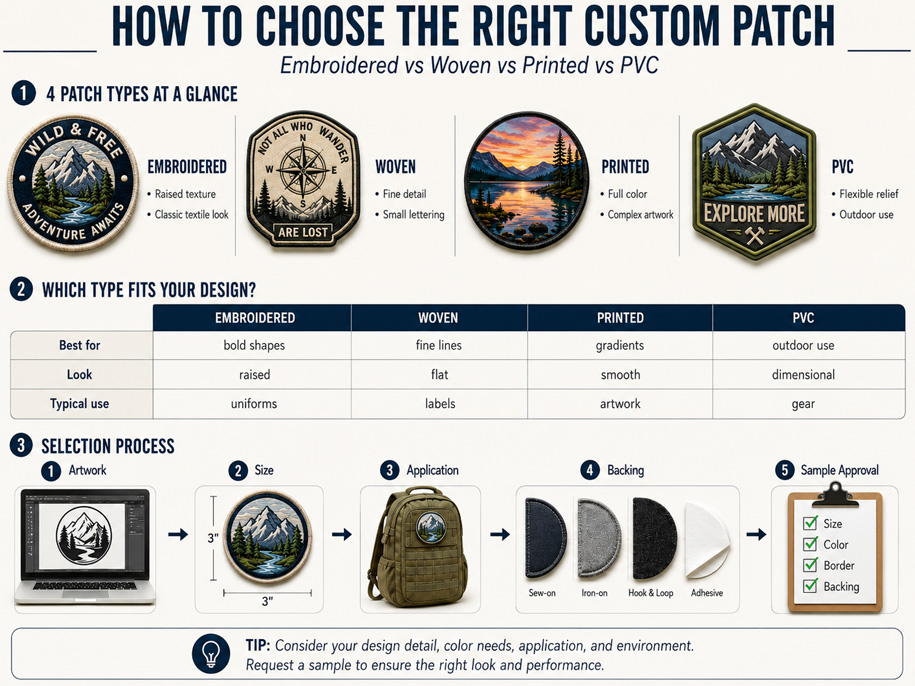
There is no single patch construction that is best for every design. Embroidered patches provide a raised, traditional textile appearance; woven patches reproduce fine lines and small lettering with a flatter surface; printed patches preserve gradients and photo-like artwork; and PVC patches provide flexible relief for products exposed to moisture and outdoor handling.
The correct choice depends on four questions: How detailed is the artwork? What surface effect should the finished patch create? Where will it be used? How will it be attached?
This custom patch selection guide explains the trade-offs so apparel brands, uniform suppliers, clubs, event organizers and promotional-product buyers can select a suitable production process before sampling.
Four Custom Patch Types at a Glance
| Patch Type | Visual Character | Main Advantage | Typical Applications | Main Limitation |
| Embroidered | Raised thread and visible stitch texture | Classic, tactile appearance | Jackets, uniforms, caps and clubs | Very small details may need simplification |
| Woven | Flat, smooth thread surface | Fine lines and smaller lettering | Fashion labels and detailed logos | Less raised texture than embroidery |
| Printed | Smooth, full-color image | Gradients and complex illustrations | Artwork with many colors or photo-like detail | Does not provide the same stitched texture |
| PVC | Flexible 2D or 3D relief | Moisture-resistant surface and dimensional effects | Outdoor gear, workwear and tactical products | Appearance is less textile-like |

1. Embroidered Patches: Best for Texture and a Traditional Finish
Custom embroidered patches build the design with thread placed over a fabric base. The stitches catch light and create a raised surface, making embroidered patches suitable when the buyer wants a recognizable textile finish.
They are commonly used on uniforms, varsity jackets, motorcycle-club garments, caps and branded workwear. Embroidery works particularly well for bold logos, clear lettering and designs with separated color areas.
However, thread has physical width. Tiny text, thin outlines and closely spaced elements can merge or lose clarity when converted into stitches. A production specialist may need to enlarge lettering, simplify a border or remove minor details during the digitizing process.
When comparing embroidered vs woven patches, choose embroidery when texture, depth and a traditional badge appearance matter more than reproducing every small line.
2. Woven Patches: Best for Fine Lines and Small Lettering
Custom woven patches form the design as part of the woven surface rather than placing embroidery on top of a separate fabric base. Finer threads and a flatter construction allow the artwork to show smaller lettering, narrow lines and compact logo details more clearly.
This makes woven patches useful for fashion branding, garment labels, detailed emblems and designs that require a textile appearance without the heavier raised surface of embroidery.
Woven patches can still use shaped edges and different backing systems, but their visual character is smoother and more refined. They are often selected when a logo contains detailed lettering that cannot be simplified without changing the brand identity.
In an embroidered vs woven patches decision, buyers should not judge from the digital artwork alone. A physical sample viewed at the final production size is the most reliable way to evaluate legibility, edge definition, thread texture and color balance.

3. Printed Patches: Best for Gradients and Complex Color Artwork
Custom printed patches transfer the visual design onto a patch substrate, allowing smooth gradients, shading and complex color transitions that are difficult to rebuild with separate thread colors.
This process is appropriate for illustrations, photographic effects, highly detailed artwork and logos containing many tonal changes. Printing can retain visual information that would otherwise need to be simplified during embroidery digitizing.
Printing is not automatically the best choice simply because the artwork contains more detail. Buyers should also consider the desired texture and the way the product will be used. A printed surface will look flatter than embroidery, while the border, substrate and backing still influence the final appearance and performance.
Before approving custom printed patches, buyers should inspect a physical sample under normal viewing conditions. Screen colors may differ from the finished product because monitors, printing processes and patch materials reproduce colors differently.

4. PVC Patches: Best for Outdoor and Dimensional Applications
Custom PVC patches use a flexible molded construction instead of textile thread. Designs can include flat color areas, raised layers and 2D or 3D effects.
Their moisture-resistant surface makes PVC patches a practical option for outdoor bags, workwear, tactical equipment and products that may encounter mud, rain or frequent handling. PVC is especially useful when a brand wants a dimensional, rubber-like appearance.
PVC patches can also use hook-and-loop backing for removable identification or equipment applications. However, buyers seeking the warmth and visual character of textile thread may prefer embroidery or weaving.
The term “water-resistant” should not be treated as a complete performance guarantee. The patch body, attachment method, garment material and finished assembly must be evaluated together for the intended environment.

How to Select the Right Patch
Buyers can use the following decision process before requesting a quotation.
1. Review the artwork
Bold shapes and clearly separated colors generally work well with embroidery. Fine lettering and narrow lines favor weaving. Gradients and photo-like details favor printing. Dimensional relief and rubber-like effects favor PVC.
2. Define the final size
A design that looks clear on a large computer screen may become difficult to read when reduced to a small patch. The artwork should always be assessed at its intended production dimensions.
3. Identify the use environment
Consider whether the finished product will face washing, abrasion, moisture, heat, sunlight, mud or repeated handling. The expected environment can be more important than appearance alone.
4. Choose the attachment method
Sew-on, iron-on, adhesive and hook-and-loop backings serve different garments and applications. The patch material and backing should be selected as one complete system.
5. Approve a physical sample
The buyer should confirm the size, colors, texture, border, backing and overall appearance before bulk production begins.
Green House can review the buyer’s original artwork, intended application and target size before recommending embroidery, weaving, printing or PVC. This review helps reduce avoidable redesign after sampling and keeps the material decision connected to the product’s actual use.
Quality Verification for Bulk Buyers
A useful sample-approval process should record more than whether the patch “looks good.” The purchase specification should identify:
- Final dimensions
- Approved artwork version
- Color references
- Border construction
- Backing type
- Attachment orientation
- Packaging requirements
- Inspection expectations
- Intended use environment

Frequently Asked Questions
Which patch is best for a detailed logo?
Woven or printed patches usually reproduce fine lines and small visual elements more effectively. The best option depends on whether the buyer wants a textile surface or printed gradients.
Which patch is best for outdoor products?
Custom PVC patches are commonly selected for moisture-exposed and frequently handled products. The complete product, including its backing and attachment, should still be evaluated for the intended conditions.
Are embroidered patches always more expensive?
Not necessarily. Price can depend on size, stitch coverage, number of colors, border, backing, quantity, artwork complexity and packaging. A meaningful comparison requires suppliers to quote the same design specifications and order quantity.
Can one design be produced in more than one patch type?
Yes. Producing alternative samples can help buyers compare surface texture, detail reproduction, color appearance and flexibility at the actual finished size.
Can a detailed logo be converted into embroidery?
Usually, but some elements may need adjustment. Small lettering may need to be enlarged, thin lines may need to be widened, and minor details may need to be removed. These changes should be approved before sampling.
Which backing should buyers choose?
Sew-on backing is suitable for permanent attachment. Iron-on backing offers convenient heat application on compatible fabrics. Hook-and-loop backing works for removable patches, while adhesive backing is generally used for temporary or specialized applications.
Conclusion
Choose embroidery for tactile tradition, weaving for fine textile detail, printing for gradients and complex images, and PVC for flexible, dimensional outdoor applications.
The most reliable selection process combines artwork review, intended-use analysis, a physical sample and a written quality specification. A custom patch selection guide can help buyers narrow down the production method, but final approval should always be based on the actual product size and use environment.
For buyers who are uncertain about the correct construction, Green House can evaluate the logo, target dimensions, application and backing requirements before preparing a sample.

Inside a Custom Embroidered Patch: What Determines Quality?
Why Gift Sets Are Becoming the Future of Brand Merchandise
Related Article