From DIY Desktops to Global Factories: The 3D Printed Keychain Revolution
author: Cindy
2025-07-25

The Keychain Reborn: More Than Just a Metal Ring
Imagine holding a miniature, perfectly detailed model of a Koenigsegg CC850 hypercar—every contour preserved in matte stainless steel—or a keychain shaped like your pet’s face, colored in photorealistic shades. This is not science fiction; it’s today’s reality in the 3D printed keychain industry. What began as a niche hobbyist pursuit has exploded into a $1.2B global market, driven by radical advances in multi-material printing, AI-powered customization, and on-demand sustainable manufacturing. For businesses, this shift isn’t just about novelty—it’s about survival in an era where personalization and speed define consumer loyalty.
1. The Evolution: From Garage Prototypes to Industrial-Grade Production
Early 3D printed keychains faced critical limitations: monochrome plastics, brittle structures, and painfully slow output. The breakthrough came when technologies like screw extrusion printing (pioneered for ultraflexible magnetic actuators) entered the mainstream. By adapting methods originally developed for high-strain industrial components, manufacturers can now print keychains with embedded flexibility, magnetic functionality, and metallic finishes—all without traditional assembly lines.
Simultaneously, AI design tools like those used by Syntilay for footwear transformed customization. Users scan objects (e.g., a car logo or handwritten signature) via smartphone, and algorithms convert them into print-ready 3D models in minutes—eliminating CAD expertise barriers.
2. The Manufacturing Revolution: Precision at Scale
A. Cutting-Edge Techniques
Hybrid Molding-Printing: Combining injection molding with printed surfaces (as seen in 3D colored buttons), manufacturers layer transparent polymers over digitally printed patterns. The result? Vibrant, scratch-resistant graphics encapsulated under domed resin—ideal for brand logos or portraits.
Direct Metal Laser Sintering (DMLS): Industrial printers fuse stainless steel or zinc alloy powders into complex geometries (e.g., lattice chains or hollow charms) with ±0.1mm precision. Post-processing includes matte polishing for scratch resistance—critical for premium keychains.
Multi-Material Jets: Printers like those from Stratasys J8 series simultaneously lay down rigid, flexible, and transparent resins. Imagine a keychain with a rubberized grip section, a crystalline emblem, and integrated LED housing—all printed in one job.

B. Accelerating Time-to-Market
While traditional metal keychains required 15–20 days for mass production, 3D printing slashes this to 7 days—even for batches as small as 100 units. German firm igus demonstrated this agility with its **readychain® p-rack*, 3D printing custom transport frames in 36 hours using plant-based materials—a model keychain makers now emulate.
3. The Customization Wave: Your Data, Your Design
AI-Driven Personalization
Platforms like Syntilay’s shoe configurator leverage Generative Adversarial Networks (GANs). Upload a photo of your dog, and the AI not only extracts outlines but suggests optimal 3D geometries for durability. For keychains, this means converting 2D art into topologically optimized charms (e.g., reducing weight by 40% while preserving detail).
No-Minimum Orders
Unlike conventional manufacturing (with 100-piece MOQ), companies like OPdesign offer single-unit production without cost penalties. Their Koenigsegg keychain—a 2.36-inch metal replica—showcases how low-volume, high-margin products thrive in this model.
4. Material Innovations: Beyond Plastic and Metal
Material Key Properties Applications
Corn Starch Biopolymers Lightweight, 100% recyclable Eco-friendly charms
Magnetic TPRs Flexible, responsive to magnetic fields “Gripping” keychains
Peek Carbon Fiber Aerospace-grade strength, heat resistance Industrial keychains
These materials align with 2025’s 3D printing trends, where bio-based resins and recycled powders dominate R&D.
5. Sustainability: The Hidden Competitive Edge
Traditional keychain manufacturing wastes up to 30% metal/plastic during milling or casting. 3D printing’s additive process cuts this near zero. Zellerfeld, Syntilay’s print partner, uses 100% recyclable polymers, allowing customers to return old keychains for re-pelletizing into new products. As Google searches for “sustainable keychains” surge by 48% YoY, this isn’t just ethical—it’s business-critical.
6. Real-World Applications: Where Keychains Become Tools
Brand Amplifiers: Companies embed QR codes or AR markers into keychain designs (e.g., scanning unlocks product demos). igus uses AR to showcase its p-rack—a tactic keychain marketers now adopt.
Functional Devices: Using ultraflexible magnetic printing, keychains integrate bottle openers, USB drives, or even RFID access tokens.
Collectibles & Memorabilia: Limited-edition keychains (e.g., concert merch) printed on-location within hours.

7. The Road Ahead: What 2026 Holds
3D Printing: Keychains that change shape with temperature/light (e.g., snowflake designs “blooming” in cold weather).
Blockchain Integration: NFT-linked keychains with digital twins for authentication.
Hyper-Localization: Mobile printing vans at events for instant customization.
Conclusion: The Key(chain) to Future-Proof Business
The 3D printed keychain is no longer a trinket—it’s a microcosm of manufacturing’s future. For entrepreneurs, this means:
- Embrace micro-factories—invest in printers like HP Multi Jet Fusion or Desktop Metal X for hybrid batches.
- Partner with AI designers—tools like Vizcom turn sketches into 3D models in seconds.
- Lead with sustainability—bio-materials are now a Top 5 purchase driver (McKinsey, 2025).
The revolution isn’t coming; it’s in your hands. Literally.
For further industry insights, explore innovations from Syntilay or multi-material 3D printing trends.
2025 Series: Customized Embroidery Patch AI Design Tools Meet Diverse and Personalized Needs
Top 10 Uses for Custom Lapel Pins: Military, Corporate & Event Branding Ideas
Related Article

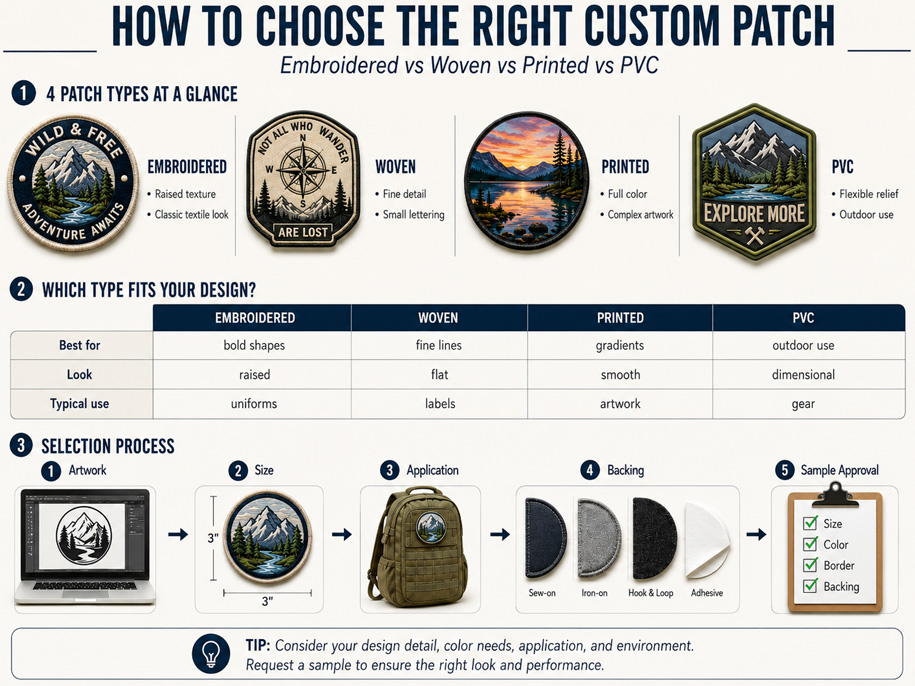
Explore when custom printed iron on patches, sublimation patches, and full color custom patches are better for photos, gradients, fine details, and smooth color transitions.
When Printing Works Better Than Thread

Improve patch performance by learning how to digitize logo for embroidery, select suitable patch backing, and optimize stitch density embroidery for clean, durable results.
Inside a Custom Embroidered Patch: What Determines Quality?