Marathon & Sports Award Medals: The B2B Event Organizer's Technical Sourcing
Executive Summary
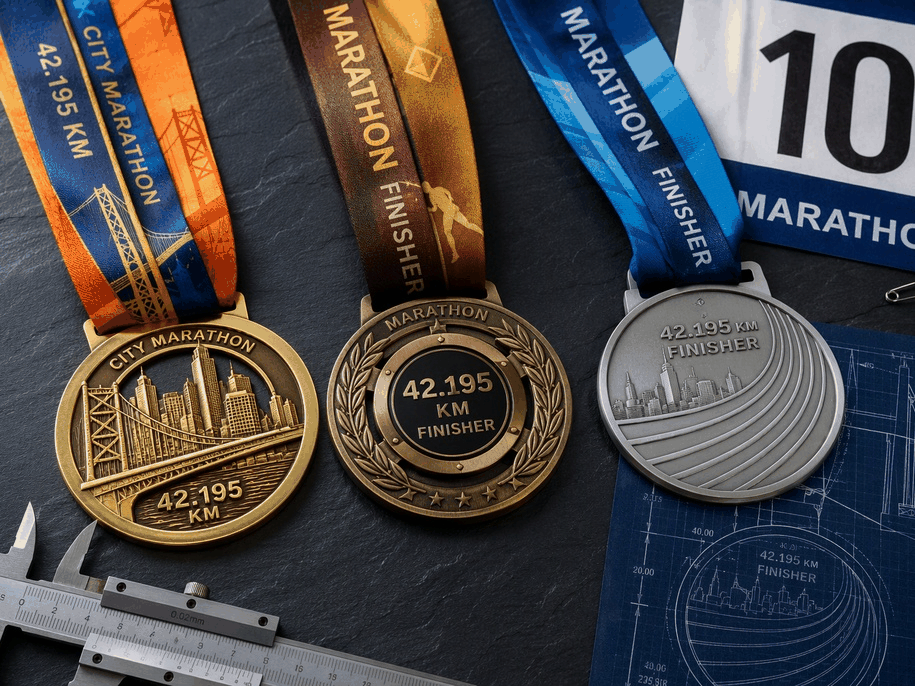
Unlike retail fashion accessories or desk collectibles, marathon and athletic finisher medals operate within high-stress event environments. A finisher medal is awarded to exhausted, sweat-soaked runners at the conclusion of intense physical exertion, worn over soaked technical apparel, bounced vigorously against the chest, and photographed immediately for global broadcast and social media.
For race directors, athletic federation procurement leads, and sports marketing agencies, sourcing mass-scale finisher awards involves challenges found nowhere else in custom manufacturing:
- Drop-Dead Delivery Reliability: A race date cannot be postponed; missing a delivery window by 24 hours results in catastrophic PR failure.
- Post-Race Ergonomics: Balancing impressive heavyweight hand-feel against neck chafing, sternum impact, and ribbon breathability.
- Viral Design Engineering: Incorporating multi-race interlocking puzzle mechanics, high-relief architectural cutouts, and kinetic spinners that drive runner registration numbers year-over-year.
1. Ergonomic Finisher Architecture: Weight, Thickness, and Sternum Impact
When designing a 75mm to 100mm marathon finisher medal, raw weight is a double-edged sword. While runners expect a substantial, high-prestige award, excessive weight combined with an improper center of gravity creates physical discomfort during post-race walking and photo sessions.
Finisher Ergonomic Envelope:
- 5K & Fun Runs: 60mm–70mm diameter | 3.0mm–3.5mm thickness | 65g–85g target weight
- Half Marathon (21K): 70mm–80mm diameter | 3.5mm–4.0mm thickness | 90g–120g target weight
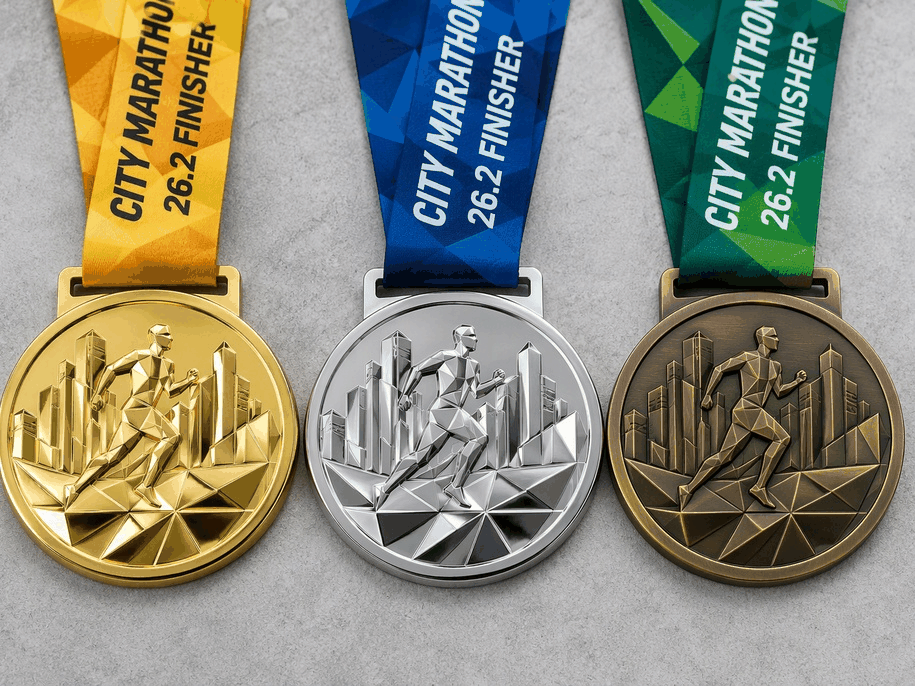
- Full Marathon (42K) & Ultra-Trail: 85mm–100mm+ diameter | 4.5mm–5.5mm thickness | 140g–190g target weight
Critical Ergonomic Engineering Rules:
- The 180-Gram Boundary: Medals exceeding 180 grams must utilize a minimum 38mm (1.5-inch) neck ribbon. A standard 25mm ribbon concentrates high downward pressure on the cervical spine, causing skin irritation on sweat-softened necks.
- Perimeter Chamfering & Edge Radii: The rear face of a finisher medal must feature smooth, rounded edge chamfers (minimum 0.5mm radius). Sharp reverse-side edges repeatedly strike the runner's sternum with every stride after crossing the finish line.
- Skeleton Architecture for Weight Balancing: For massive 90mm+ medals, utilizing internal cut-out windows (skeletonized designs) reduces overall dead-weight by 20% to 30% while expanding the perceived visual footprint.

2. Advanced Interactive Mechanics: Interlocking Series & Spinner Medals
Modern endurance events rely heavily on gamified medal series to drive multi-race registrations and retention.
Interlocking Multi-Race Puzzle Medals
Series organizers (e.g., Seasonal 4-Race Challenges, Triple Crowns, or Regional 100K Circuits) procure individual stage medals that physically connect into a unified master display emblem upon series completion.
- Magnetic Alignment Systems: Small, corrosion-resistant neodymium disc magnets (N35 grade, nickel-plated) are recessed into internal side cavities of the die-cast frame and sealed with waterproof marine-grade epoxy. When brought together, adjacent medals self-align and snap shut with a firm tactile click.
- Precision CNC Mortise & Tenon Joints: Alternating male tab and female slot joints are engineered along adjacent edges with an engineering tolerance of ±0.08mm. This ensures smooth hand assembly without loose wobbling or binding friction.
Kinetic Mechanics (Spinners, Hinges & Sliding Elements)
Finisher engagement surges when awards contain dynamic mechanical elements:
- Centerpiece Axle Spinners: An inner medallion (e.g., event year, rotating compass rose, or spinning runner silhouette) is mounted on dual micro-axle pins inside an outer suspension ring. High-precision concentric reaming guarantees smooth, wobble-free rotation.
- Integrated Secondary Utilities: Seamlessly recessing a functional crown bottle opener hook into the bottom rim transforms the medal into an immediate post-race celebration tool, significantly extending its daily post-race utility.
3. Ribbon Engineering: Sweat-Resistant Textiles & Race-Safe Assembly
The ribbon represents 50% of the wearer's tactile experience and serves as the primary billboard for race sponsors in finish-line media photography.
Textile Weave Performance Matrix
| Performance Metric | Ultra-Dense Sublimated Satin Polyester | Tubular Double-Knit Jacquard | Ribbed Grosgrain Weave |
| Skin Friction (Sweat Test) | Lowest: Friction coefficient < 0.2; zero chafing on wet skin | Moderate: Soft cushioned feel; slight friction under heavy bounce | High: Pronounced horizontal ribs can irritate sensitive collarbones |
| Sponsor Logo Fidelity | Photographic: Micro-gradients, QR codes, unlimited sponsor logos | Bold Geometric Only: Limited to 4–6 solid dyed yarn colors | Basic: Single-color screen print only; prone to cracking when folded |
| Moisture Absorption | Hydrophobic fibers; dries rapidly without water-logging | Retains moderate moisture in high humidity | Minimal absorption; stays relatively stiff |
| Edge Curl Resistance | Superior dimensional stability with ultrasonic hot-knife edges | Thick self-stabilizing double-sided tube | Tends to fray if edge threads are snagged |
- The V-Neck Cross-Stitch Standard: High-end athletic medals must be assembled with a formal V-neck sewn fold. This forces the medal to hang perfectly flat against the runner's sternum rather than twisting 90 degrees as occurs with cheap top-ring loop ties.
- Youth & Trail Safety Breakaways: For scholastic, obstacle course (OCR), and youth races, integrating a spring-loaded plastic breakaway clasp at the back of the neck prevents dangerous snagging on trail branches or race corral barriers.
- Sublimated Print Layout Rules: Sponsor logos must be concentrated along the lower 15cm to 25cm of the ribbon chest drapes, ensuring brand visibility remains unobstructed by long hair or race bib numbers during winner podium ceremonies.

4. Reverse-Side Engineering: Timing Chips & Custom Finisher Engraving
While the front face carries visual prestige, the reverse face serves an operational and personalization function.
Laser-Friendly Blank Banners
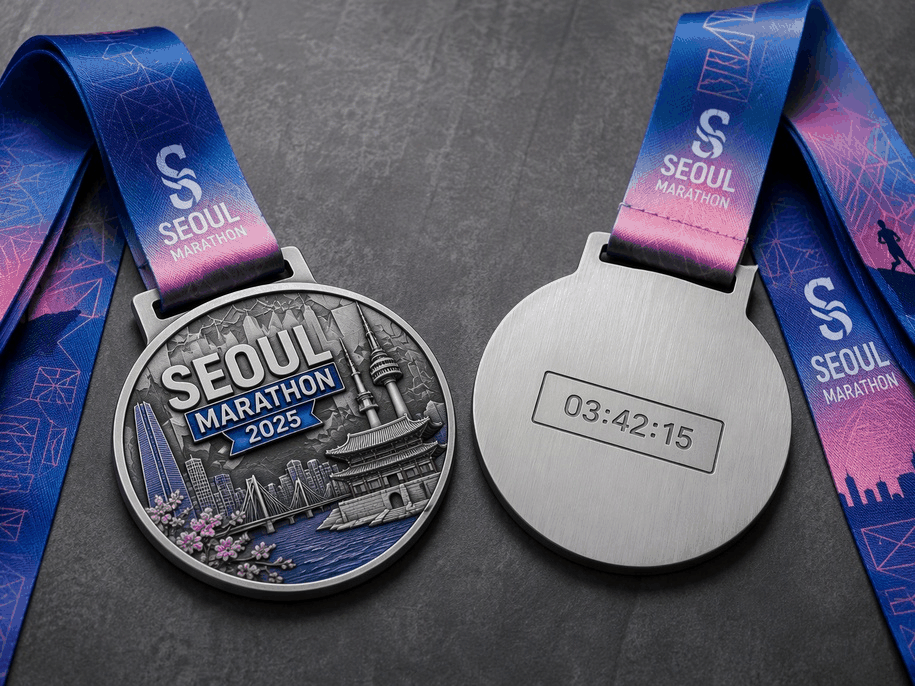
Mass events offering on-site post-race engraving (runner name, bib number, and official chip time) must plan the reverse-side typography with strict depth boundaries:
- Recessed Engraving Recess: A smooth, mirror-polished flat bar (minimum dimensions: 35mm x 12mm) recessed 0.3mm below the surrounding perimeter rim protects custom fiber-laser engraving from pocket abrasion.
- Coating Compatibility: Polished shiny nickel, gold, or anodized black finishes yield crisp, high-contrast laser ablation marks, whereas porous antique washes can result in fuzzy, low-legibility text.
5. Event Logistics & Mass Production Milestones: The "105% Buffer Rule"
Managing custom manufacturing for 1,000 to 50,000 finishers requires reverse-engineering the production schedule from the opening of the runner registration expo.
Standard Sourcing Timeline (Working Backwards from Race Day):- Race Day (D-Day)
- D - 7 Days: Bulk shipment cleared through customs and arrived at race warehouse
- D - 15 Days: Air freight transit & customs documentation release
- D - 30 Days: Full mass production completion & AQL final inspection sign-off
- D - 50 Days: Mass die-casting, plating, color fill, and automated ribbon sewing
- D - 65 Days: Physical pre-production sample approval (weight, dimensions, ribbon drape)
- D - 75 Days: CNC steel tooling cut and 3D digital displacement proof sign-off
Sourcing Pitfalls & Risk Mitigation:
- The 105% Buffer Calculation: Final race registration counts frequently fluctuate in the final 30 days. Standard procurement protocol dictates ordering 105% of projected capacity. Producing an emergency secondary run of 200 medals after mass molds have been broken down costs significantly more than a 5% initial surplus.
- Split Sea/Air Logistics: For massive runs (10,000+ units), cost-conscious organizers ship 80% via ocean freight 60 days prior, holding the remaining 20% buffer for express air courier once final registration brackets close 15 days before the event.
- Corrosion-Proof Packaging for Sea Freight: Bulk ocean transit subjects metal goods to intense humidity and salt air. Medals must be packed in moisture-sealed cartons with industrial silica desiccant pouches to prevent electroplating oxidation prior to race day unboxing.
| Sourcing Parameter | Standard 5K/10K Finisher Medal | Premier City Marathon (42K) Award | Multi-Race Interlocking Challenge Series |
| Typical Diameter | 65mm–70mm | 85mm–100mm | 75mm–90mm per individual stage |
| Finished Thickness | 3.0mm–3.5mm | 4.5mm–5.5mm | 4.0mm–5.0mm (Precision matched) |
| Ribbon Width | 25mm–30mm | 38mm (Wide ergonomic drape) | 38mm with stage-specific custom graphics |
| Mechanical Complexity | Solid single casting | Deep 3D reliefs + skeleton cutouts | Embedded neodymium magnets or mortise joints |
| Engraving Area | Pre-cast generic text | Dedicated laser banner for chip time | Sequential interlocking stage markers |
| Production Lead Time | 20–25 days | 30–35 days | 40–45 days (Multi-die alignment check) |
Frequently Asked Questions (FAQ)
Q1: Why do marathon medals hang twisted on runners, and how is it engineered out?
Medals twist when connected via a single round jump ring or when using a standard straight ribbon loop. To ensure medals hang completely flat facing the camera, the top of the medal must incorporate an integrated cast horizontal ribbon slot (matching ribbon width), and the ribbon must be sewn with a calibrated 45-degree V-neck fold.
Q2: What is the minimum lead time required for an emergency medal re-order?
If steel molds are already cut and stored from the primary production run, express re-casting and sublimation ribbon printing can be completed in as few as 10 to 12 business days, followed by priority 3-to-5-day air courier. However, initial order planning should always include a 5% buffer to avoid expedited shipping surcharges.
Q3: How do magnetic interlocking medals hold up in wet or rainy races?
Race-grade interlocking medals utilize nickel-plated N35 neodymium magnets completely encapsulated within internal die-cast pockets and sealed with marine-grade waterproof resin. This guarantees magnets will not rust, corrode, or detach even when exposed to heavy rain, runner sweat, or post-race washing.
Q4: Which printing method is best for complex, multi-sponsor neck ribbons?
Full-color dye sublimation (heat-transfer satin) is the undisputed global standard for marathon neck ribbons. Unlike screen printing, which cracks and stiffens the fabric, sublimation embeds high-resolution inks directly into the polyester yarn, preserving total silk-like softness against the neck while rendering micro-fine sponsor logos with absolute clarity.
Conclusion & Factory-Direct Event Collaboration
Finisher medals are the ultimate tangible embodiment of an athlete's dedication and the defining centerpiece of your event's brand identity. Sourcing successful finisher awards requires an engineering partner who understands that delivery deadlines are absolute, ergonomics matter as much as aesthetics, and mechanical reliability elevates runner satisfaction.
Shenzhen Gelinjia Technology (GreenHouse / mcpatch) specializes in high-volume athletic award production, operating fully integrated die-casting, automatic coloring, in-house ribbon sublimation printing, and precision mechanical assembly lines. From multi-race magnetic interlocking systems to heavyweight ultra-marathon medallions, our engineering team ensures your race awards cross the finish line flawlessly.
Related Article