Custom Embroidered & Woven Keychains (Jet Tags): The Technical B2B Sourcing & Manufacturing Guide
Executive Summary
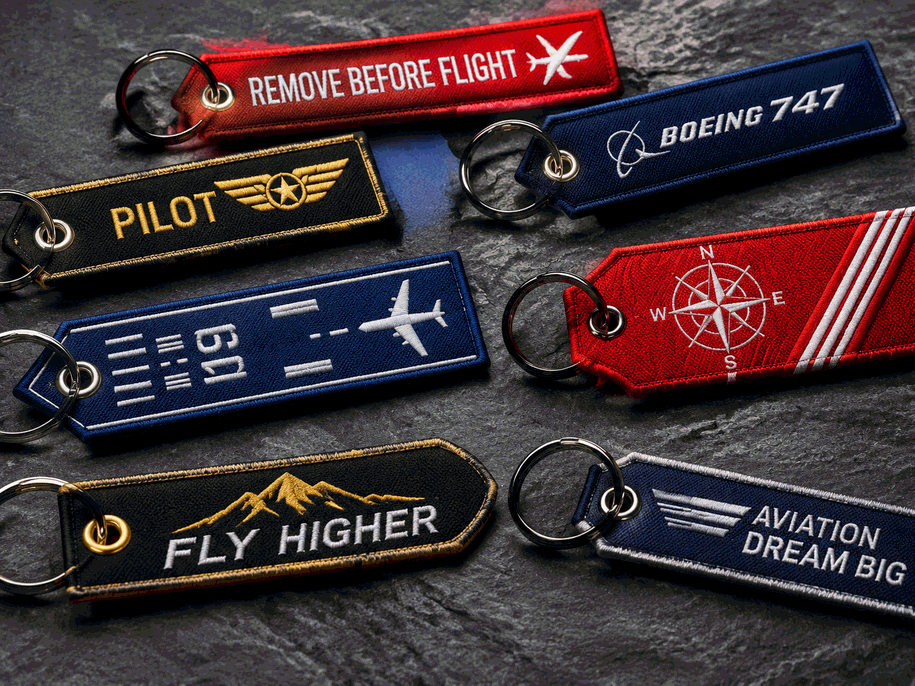
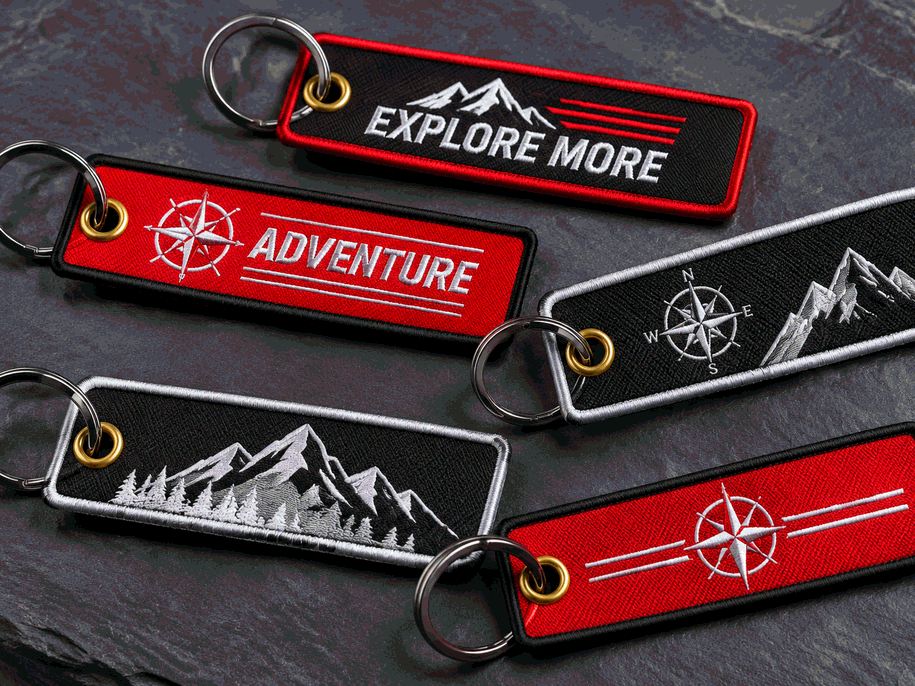
Fabric-based key accessories-commonly produced as a custom embroidered keyring, industrial custom flight tags, or a high-density woven key chain-occupy a unique functional niche in promotional merchandise, automotive aftermarket, aviation ground support, and tactical apparel sectors. Unlike die-cast zinc alloy or stamped brass keychains, fabric tags provide two critical engineering advantages: they are flexible and will not scratch delicate painted, anodized, or polished surfaces, and they eliminate metallic resonance and rattle in dynamic operating environments.
For procurement managers, brand apparel merchandisers, and event directors, sourcing fabric key tags at commercial volume requires balancing visual resolution with structural longevity. Common production pitfalls include distorted typography on narrow ribbons, edge unraveling after pocket friction, fabric curling caused by low-grade core stiffeners, and grommet eyelet tear-out under tensile loads.
This technical guide bypasses generic promotional advice. It details the mechanical differences between needle embroidery and high-definition weaving, establishes dimensional limits for legible text and logos, breaks down composite multi-layer anti-curling construction, evaluates border finishing methods, rigorously examines hardware crimping retention, and outlines factory inspection tolerances for mass production.
1. Process Comparison: Embroidered Keyring vs. Woven Key Chain
The choice between embroidery and jacquard weaving dictates visual fidelity, tactile profile, and cost structure. Understanding how both processes interact with thread thickness and substrate density prevents legibility failure before cutting bulk tooling.
Mechanical Differences
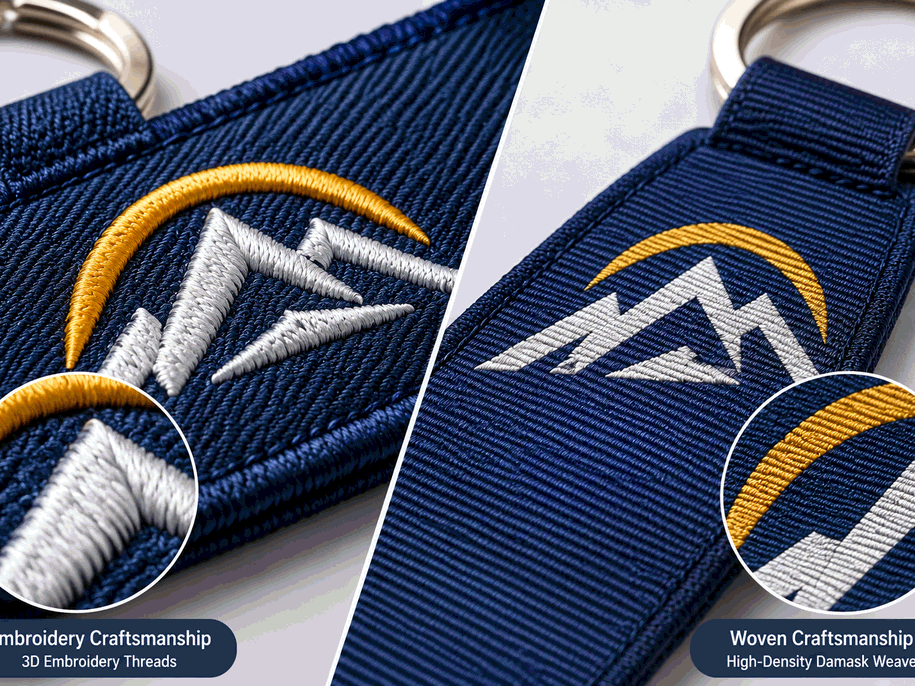
- Custom Embroidered Keyring (Stitch on Substrate): Uses computerized multi-head needles to stitch 100% spun polyester thread (typically 120D/2 specification) into a pre-cut heavy cotton-polyester twill base. Because threads sit atop the fabric, embroidery produces a pronounced three-dimensional relief with strong light reflection. However, needle punch spacing limits how closely two stitches can sit without perforating the base fabric.
- Woven Key Chain (Interlaced Yarn Architecture): Created on computerized high-speed damask rapier looms. Warp and weft threads (using ultra-fine 50D, 75D, or 100D polyester filaments) interlace simultaneously to construct the entire fabric body, text, and artwork from scratch. The result is a smooth, continuous, flat ribbon with zero raised relief, but with triple the resolution capacity of needle embroidery.
| Engineering Metric | Custom Embroidered Keyring | High-Density Woven Key Chain | Factory Verification |
| Yarn / Thread Gauge | 120D/2 to 150D/2 Rayon/Polyester | 50D to 100D Filament Polyester | Denier inspection |
| Minimum Text Height | 4.5 mm to 5.0 mm | 2.0 mm to 2.5 mm | Optical reticle / Caliper |
| Minimum Line Weight | 0.8 mm to 1.0 mm | 0.25 mm to 0.3 mm | Vector line-check |
| Surface Profile | 3D raised relief, tactile texture | Completely flat, satin-smooth | Tactile & profile gauge |
| Gradient / Micro Detail | Coarse color stepping only | Tight color transitions | Proof comparison |
| Substrate Construction | 100% Poly-cotton twill foundation | Self-formed woven damask ribbon | Material spec sheet |
| Abrasion Resistance | Moderate (threads can snag on keys) | High (interlocked weft structure) | Taber abrasion test |
| Relative Unit Tooling | Lower digitizing charge | Slightly higher loom setup cost | Pre-production quote |
Production Rule for Artwork Selection
- Choose an embroidered keyring when your logo features bold lettering, simple badges, military emblems, or when you require a rugged, three-dimensional physical presence.
- Choose a woven key chain when the graphic contains small copyright marks, sponsor URLs, QR codes, complex gradients, tight serif fonts, or detailed schematic silhouettes.
2. Multi-Layer Construction & Anti-Curling Core Engineering
A frequent defect in cheap fabric tags is 'banana curling'-where the tag bows or twists after several weeks in a pocket. This is caused by environmental humidity differences between the front and back fabric layers, or by insufficient internal rigidity. Industrial-grade key tags use a calibrated three-layer sandwich construction:
- 1. Face Layer (Outer Display): Heavy polyester twill (for embroidery) or high-density damask fabric (for woven designs).
- 2. Structural Core Layer (Internal Stiffener): Standard commercial spec uses 250 g/m² to 350 g/m² high-density non-woven chemical sheet, double-side laminated with thermal heat-seal adhesive film. Heavy-duty tactical spec uses 0.8 mm to 1.2 mm flexible EVA or compressed composite PVC board for applications requiring zero flex in harsh environments.
- 3. Backing Layer (Reverse Display): Can feature identical embroidered/woven artwork, complementary secondary text, or smooth twill backing. Both sides are fused under pneumatic hot-press presses (160°C to 180°C under 4 to 6 bar pressure) prior to border stitching.
3. Border Finishes: Merrowed Overlock vs. Laser Heat-Seal Cut
The perimeter border secures all three structural layers and stops yarn fraying. Two distinct methods serve different profile geometries:
1. Merrowed Overlock Border (Traditional Rolled Edge)
- Mechanics: A dedicated 3-thread overedge sewing machine wraps heavy polyester or rayon yarn completely around the outer perimeter, enclosing the face, core, and backing.
- Border Width: Consistently 3.0 mm to 4.0 mm wide.
- Geometric Limits: Rectangles, ovals, and gentle geometric curves only. Overlock needles cannot negotiate sharp internal 90-degree angles, deep notches, or jagged mascot silhouettes.
- Best Applications: Classic custom flight tags, rectangular luggage tags, and vintage motorsport tags.
2. Laser Heat-Cut Border (Sealed Die-Cut Edge)
- Mechanics: An optical CNC laser beam cuts along the vector contour of the tag. Concentrated thermal energy instantly melts and fuses synthetic polyester fibers of all layers simultaneously, creating a sealed, fray-resistant edge.
- Geometric Limits: Can trace any complex profile-custom contour shields, vehicle outlines, wrench silhouettes, and angular tactical shapes.
- Edge Profile & Reinforcement: Flat with a visible edge seam; slightly firmer to the touch than a merrowed border. Often paired with an internal 2.0 mm flat satin stitch just inside the laser-cut edge to reinforce mechanical shear strength.

4. Hardware Assembly, Eyelet Crimping & Tensile Retention Standards
In practical mechanical evaluation, a fabric key tag's functional lifespan is rarely limited by fabric wear; it is dictated by the structural integrity of the metal eyelet junction. Hardware failure primarily occurs through two distinct failure modes: eyelet tear-out (pull-through from the textile substrate) and permanent plastic deformation of the split ring.
[Split Key Ring: 28mm-32mm Hardened Flat Wire / High Elastic Limit]
│
[Direct Mechanical Interlock / Free Swivel]
│
[Deep-Draw Solid Brass Eyelet / Double-Curled Flange]
[Outer Flange: 9.5mm - 11.0mm | Bore Diameter: 5.5mm - 6.5mm]
│
[Safety Edge Distance: 6.0mm - 8.0mm Inward]
│
[Hot-Laminated 3-Layer Composite Fabric Body (130mm x 30mm)]
1. Eyelet (Grommet) Metallurgy & Crimping Mechanics
- Substrate Metallurgy: Industrial specifications mandate solid deep-drawing brass (H65/H68 grade) or austenitic stainless steel. Recycled zinc-aluminum die-cast grommets must be strictly avoided: their brittle crystal structure fractures micro-cracks along the perimeter flange during pneumatic crimping, drastically reducing shear tolerance.
- Flange Curling Geometry: The eyelet punch die must produce a uniform 360-degree radial rollover (double-curl flange) without sharp burrs. A properly curled flange mechanically compresses the internal non-woven core, creating a friction lock that resists rotational loosening.
- Safety Edge Margin: The center axis of the eyelet bore must maintain a minimum clear distance of 6.0 mm to 8.0 mm from the inner edge of the merrowed border. Positioning the eyelet closer to the boundary reduces the transverse yarn cross-section, causing premature textile tear-out under dynamic shock loads.
2. Corrosion Resistance & Environmental Testing
- Plating Chemistries: Standard commercial options include barrel-plated bright nickel, gunmetal black, antique bronze, and matte black cathodic electrophoresis.
- Salt-Spray Compliance: All metal components should pass neutral salt-spray testing (minimum 24 hours per ASTM B117 / ISO 9227 standards) without red rust, zinc bloom, or surface pitting, ensuring operational resistance to rainwater, road salt, and fuel exposure.
3. Factory Tensile Retention Benchmarks (Pull-Force Limits)
- Standard Commercial Baseline (Factory Reference Range): The crimped eyelet and ring assembly should withstand a sustained linear tensile load of 100 N to 130 N (approx. 10.2 kgf to 13.3 kgf) without textile tear-through or flange dislocation. (Factory benchmark; client-specific requirements should be validated on pre-production samples).
- Reinforced Tactical / Flight Duty Grade: Achieves tensile retention of ≥ 200 N (approx. 20.4 kgf) by integrating an internal high-tenacity polyester filament webbing anchor between the twill layers surrounding the eyelet bore.
- Split Ring Plastic Deformation Limit: Flat-wire tempered steel split rings should demonstrate 100% spring-back memory after opening up to 3.0 mm for key insertion, resisting permanent wire splaying under a 50 N lateral pull.
5. Vertical Application Demands: Why Automotive and Aviation Buyers Specify Fabric
Procurement teams in the motorcycle, automotive tuning, and aviation ground operations sectors consistently prefer fabric tags over metal or rigid plastic key rings:
- 1. Zero-Scratch Protection (Triple-Tree & Paint Preservation): On motorcycles, jet skis, and sports cars, keys dangle directly against anodized aluminum triple-tree clamps, clear-coated fuel tanks, and lacquered carbon-fiber consoles. Hard metal keychains vibrate at highway speeds, scouring surfaces within miles. A custom embroidered keyring or woven key chain acts as a soft buffing contact, eliminating paint and surface scratches.
- 2. Anti-Rattle & Acoustic Neutrality: In performance cockpits and automotive interiors, metal-on-metal key bundles produce irritating resonance at specific RPM frequencies. Fabric tags absorb vibrations and damp contact noise.
- 3. High Tactile Visibility (The 'Jet Tag' Ergonomic Form Factor): Standard dimensions for custom flight tags (130 mm x 30 mm or 120 mm x 25 mm) originated as high-visibility warnings in aircraft maintenance. In daily life, this long, flexible form factor allows users to grab keys effortlessly from deep pockets, tank bags, or motorcycle gloves without looking.
6. Functional Threads & Specialty Upgrades
Upgrading core thread materials transforms basic promotional tags into high-value functional gear:
- 3M-Grade Retro-Reflective Yarn: Micro-prismatic glass-bead reflective thread woven into border merrowing or background striping. Reflects vehicle headlights directly back to drivers, providing passive nighttime safety for cyclists, runners, and motorcyclists.
- Phosphorescent (Glow-in-the-Dark) Thread: Photoluminescent pigment embedded in polyester fibers. After 10 minutes of daylight exposure, it emits a green or aqua glow for up to 6 hours in dark environments-ideal for emergency equipment keys and night aviation crews.
- Metallic Lurex (Gold / Silver) Thread: Polyester filament wrapped in vaporized aluminum film. Delivers crisp jewelry-style metallic sheen without the bulk or weight of solid metal castings. Recommended for anniversary editions and VIP dealer gifts.
7. B2B Quality Control & Factory Pre-Shipment Inspection Checklist
Before authorizing the release of mass production runs, procurement specialists should review goods against this standardized quality control protocol:
| Inspection Category | Defect Description | Acceptance Criteria (AQL 2.5) | Corrective Action |
| Dimensional Limits | Length/width exceeds target by > 2.0 mm | Max deviation ± 1.5 mm from tech pack | Re-calibrate automated hot cutters |
| Typography / Stitches | Jump threads visible between letters | 100% clean thread trimming; zero thread bridges | Hand-trimming or laser shear |
| Border Alignment | Merrowing skips stitches; corner fabric exposed | Continuous 3-thread overlock with tight density | Re-thread machine; re-run edges |
| Eyelet & Piercing | Off-center bore; flange splits or bites border | Centered within ± 0.8 mm; no cracked metal | Adjust die pressure; replace punch tool |
| Colorfastness (Wash/Rub) | Dye transfer to white testing fabric under friction | Grade ≥ 4.0 on AATCC Gray Scale | Pre-wash and use colorfast yarn |
| Curling / Flatness | Tag flexes > 5 mm off flat plane when rested | Flat within 2.0 mm on inspection stone | Increase core weight; check cooling |
8. Frequently Asked Questions (B2B Procurement FAQ)
- Q1: What is the standard turnaround time for custom embroidered keyrings and woven flight tags? Digital embroidery simulations or woven CAD vector proofs take 24 to 48 hours. Physical pre-production samples require 3 to 5 business days upon proof sign-off. Bulk mass production (500 to 5,000 pieces) typically completes within 8 to 12 business days, depending on border type and packaging specifications.
- Q2: Can we print different designs on the front and back of the same tag? Yes. Full two-sided customization is standard. You can combine identical designs, contrasting slogans (e.g., brand name on front, corporate hotline/URL on back), or even mix techniques (e.g., bold embroidered lettering on the front, high-density woven fine print on the back).
- Q3: What is the standard packaging, and do you support custom retail-ready packaging? Standard export packaging includes individual sealed OPP protective polybags, grouped into cartons of 50 or 100 units. For retail brands and e-commerce distribution, we produce custom printed backing cards (350 g/m² artboard with full-color offset printing), euro-slot hanging holes, and scannable GS1/FBA barcode labeling.
| Specification Field | Standard Factory Range | Heavy-Duty Tactical / Premium |
| Standard Tag Dimensions | 130 mm x 30 mm / 120 mm x 25 mm | Custom die-cut up to 150 mm x 40 mm |
| Total Finished Thickness | 2.2 mm to 2.8 mm | 3.0 mm to 3.5 mm (dual-core stiffener) |
| Base Fabric Options | Poly-cotton Twill, Heavy Canvas, Felt | High-density Damask Woven, Cordura |
| Yarn Material | 100% Spun Polyester (Colorfast) | 3M Reflective, Glow-in-Dark, Lurex |
| Border Construction | 3.5 mm Merrowed Overlock Wrap | CNC Laser Heat-Fused Contour Cut |
| Metal Eyelet / Grommet | Outer 9.5 mm, Inner 5.5 mm Deep-Draw Brass | Outer 11.0 mm, Inner 6.5 mm Stainless Steel |
| Split Ring Hardware | 30 mm Flat Wire Spring Steel Ring | 32 mm Solid Brass, Carabiner, Wire |
| Color Matching Standard | PMS ± 0.5 shade tolerance | Pantone Master Swatch under D65 box |
Conclusion & Factory-Direct Manufacturing Partnership
Fabric-based key accessories-whether in the form of a rugged custom embroidered keyring, an iconic custom flight tags banner, or a precision woven key chain-deliver high-frequency brand touchpoints while safeguarding sensitive automotive, aviation, and EDC equipment from scratches and noise.
Successfully bringing a commercial fabric tag project from concept to delivery requires an integrated supply partner capable of bridging digital embroidery punch-card programming, high-density rapier loom weaving, heat-laminated sandwich core assembly, and certified mechanical hardware crimping.
Direct Sourcing Capabilities at Shenzhen Gelinjia Technology (mcpatch)
As an established OEM/ODM specialty manufacturer, Shenzhen Gelinjia Technology (GreenHouse / mcpatch) provides full in-house fabrication across textile and metal accessories:
- Precision Digitizing & Weaving Setup: High-speed multi-head computerized Tajima embroidery machines and high-density Swiss-type damask weaving looms capable of resolving ultra-fine micro-text down to 2.0 mm.
- Structural Durability Guarantee: Calibrated pneumatic hot-press lamination and high-gauge brass eyelet crimping tested to meet commercial tensile retention benchmarks (100 N to 130 N reference range; reinforced configurations up to ≥ 200 N).
- Material & Environmental Compliance: 100% colorfast polyester yarns passing AATCC crocking standards; nickel-free, lead-free hardware meeting international RoHS and REACH environmental guidelines.
- Flexible Volume Scalability: Low minimum order quantities starting from 100 pieces for initial brand testing, with production capacity scaling to 100,000+ units per month for global distribution.
Ready to Initiate Your Production Run?
Submit your vector artwork (AI, .EPS, or vector PDF) with target dimensions and Pantone color codes to our engineering team at www.mcpatch.com to receive a complimentary digital proof and factory-direct quotation within 24 hours.

Related Article