Home ●Case Studies ●News ●How Foreign Trade Companies Should Respond to the New Situation and Seize Development Opportunities ●
How Foreign Trade Companies Should Respond to the New Situation and Seize Development Opportunities
author: Sarsh
2025-03-26
Recently, global international trade policies have undergone a series of significant adjustments, including tariff adjustments, trade agreement updates, and the introduction of green trade barriers. These changes have not only reshaped the global trade landscape, but also had a profound impact on the business of foreign trade companies. As a foreign trade enterprise committed to global development, we closely monitor these policy changes and actively take response measures to ensure competitiveness in the complex and ever-changing international market.
Latest changes in international trade policies
1. Tariff adjustment
Since 2023, multiple countries have adjusted import tariffs on certain goods. For example, the United States has raised tariffs on some steel and aluminum products, while the European Union has implemented temporary tariffs on textiles and electronic products from certain countries. At the same time, the tariff reduction policies between China and RCEP member countries have been further implemented, creating more convenience for intra regional trade.
Since 2023, multiple countries have adjusted import tariffs on certain goods. For example, the United States has raised tariffs on some steel and aluminum products, while the European Union has implemented temporary tariffs on textiles and electronic products from certain countries. At the same time, the tariff reduction policies between China and RCEP member countries have been further implemented, creating more convenience for intra regional trade.
2. Trade Agreement Update
The deepening of Regional Trade Agreements (RTAs) has become the core of international trade policy. The comprehensive implementation of the Regional Comprehensive Economic Partnership (RCEP) has significantly reduced tariff barriers among member countries and improved trade facilitation measures. In addition, cooperation between the European Union and the African Continental Free Trade Area (AfCFTA) is also accelerating, providing more opportunities for intra regional trade.
The deepening of Regional Trade Agreements (RTAs) has become the core of international trade policy. The comprehensive implementation of the Regional Comprehensive Economic Partnership (RCEP) has significantly reduced tariff barriers among member countries and improved trade facilitation measures. In addition, cooperation between the European Union and the African Continental Free Trade Area (AfCFTA) is also accelerating, providing more opportunities for intra regional trade.
3. Green trade barriers
With the increasing global attention to climate change, green trade barriers have gradually become an important component of international trade policies. The Carbon Border Adjustment Mechanism (CBAM) launched by the European Union has officially come into effect, imposing additional tariffs on high carbon emitting products. The United States, Japan and other countries have also followed suit and introduced similar green trade policies.
With the increasing global attention to climate change, green trade barriers have gradually become an important component of international trade policies. The Carbon Border Adjustment Mechanism (CBAM) launched by the European Union has officially come into effect, imposing additional tariffs on high carbon emitting products. The United States, Japan and other countries have also followed suit and introduced similar green trade policies.
4. Formulation of digital trade rules
The rapid development of the digital economy has prompted countries to accelerate the formulation of digital trade rules. The World Trade Organization (WTO) has reached a series of new agreements on issues such as digital trade tariffs, cross-border data flows, and intellectual property protection, providing policy support for the development of cross-border e-commerce and digital service industries.
The rapid development of the digital economy has prompted countries to accelerate the formulation of digital trade rules. The World Trade Organization (WTO) has reached a series of new agreements on issues such as digital trade tariffs, cross-border data flows, and intellectual property protection, providing policy support for the development of cross-border e-commerce and digital service industries.
The impact of policy changes on the company's business
1. Cost pressure caused by tariff adjustments
Some countries have raised tariffs on specific goods, directly increasing the import costs of companies. For example, the high tariffs imposed by the United States on steel and aluminum products have put higher cost pressures on foreign trade companies in related industries. We are actively adjusting our supply chain layout and seeking alternative markets and suppliers to reduce the impact of tariffs.
Some countries have raised tariffs on specific goods, directly increasing the import costs of companies. For example, the high tariffs imposed by the United States on steel and aluminum products have put higher cost pressures on foreign trade companies in related industries. We are actively adjusting our supply chain layout and seeking alternative markets and suppliers to reduce the impact of tariffs.
2. Market opportunities brought by regional trade agreements
The comprehensive implementation of RCEP provides an important opportunity for the company to expand into the Southeast Asian market. By utilizing tariff reduction policies among member countries, we can enter markets such as Japan, South Korea, and Australia at lower costs, further increasing our market share. In addition, we are actively monitoring the progress of cooperation between the European Union and the African Continental Free Trade Area, preparing for the future expansion of the African market.
3. Challenges and opportunities of green trade barriers
The implementation of EU carbon tariffs poses a huge challenge to high carbon emitting industries. As a sustainable enterprise, we are accelerating our green transformation, adopting low-carbon production technology, and obtaining internationally recognized environmental certifications. At the same time, we also see the enormous potential of green supply chain construction and are exploring low-carbon and environmentally friendly supply chain solutions with our partners.
The comprehensive implementation of RCEP provides an important opportunity for the company to expand into the Southeast Asian market. By utilizing tariff reduction policies among member countries, we can enter markets such as Japan, South Korea, and Australia at lower costs, further increasing our market share. In addition, we are actively monitoring the progress of cooperation between the European Union and the African Continental Free Trade Area, preparing for the future expansion of the African market.
3. Challenges and opportunities of green trade barriers
The implementation of EU carbon tariffs poses a huge challenge to high carbon emitting industries. As a sustainable enterprise, we are accelerating our green transformation, adopting low-carbon production technology, and obtaining internationally recognized environmental certifications. At the same time, we also see the enormous potential of green supply chain construction and are exploring low-carbon and environmentally friendly supply chain solutions with our partners.
4. Digital trade rules drive business innovation
The formulation of digital trade rules has brought development opportunities for cross-border e-commerce and digital service industries. We are accelerating digital transformation and optimizing trade processes through cross-border e-commerce platforms, electronic payment tools, and other means. At the same time, we are actively exploring the application of technologies such as big data and artificial intelligence in marketing and supply chain management to enhance overall competitiveness.
The formulation of digital trade rules has brought development opportunities for cross-border e-commerce and digital service industries. We are accelerating digital transformation and optimizing trade processes through cross-border e-commerce platforms, electronic payment tools, and other means. At the same time, we are actively exploring the application of technologies such as big data and artificial intelligence in marketing and supply chain management to enhance overall competitiveness.
Future prospects
The changes in international trade policies are both challenges and opportunities. As a globalized foreign trade enterprise, we always adhere to customer centricity, actively adapt to policy changes, accelerate transformation and upgrading, and occupy a favorable position in global competition. In the future, we will continue to strengthen communication and cooperation with governments, industry associations, and partners around the world, jointly promoting trade liberalization and facilitation, and contributing to the sustainable development of the global economy.
In the context of global economic integration, we believe that through continuous innovation and optimization, we can maintain competitiveness in the complex and ever-changing international market and achieve long-term stable development.
Stitched in Time: Stories Woven by Custom Patches, Keychains
Research and Development of Environmentally Friendly Materials and Embracing New Trends in Green Regulations in Europe and the United States
Related Article

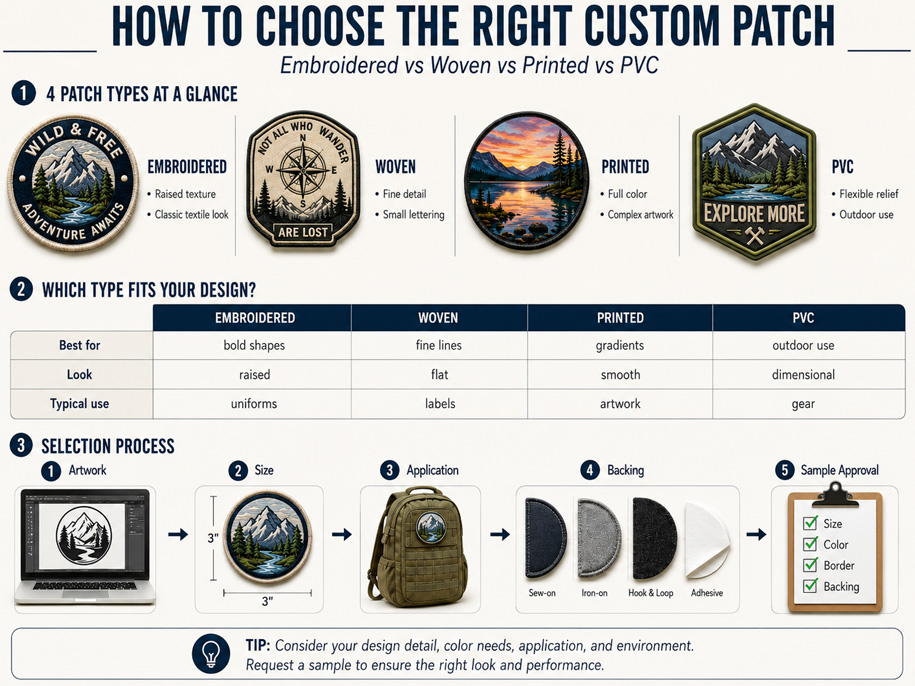
Explore when custom printed iron on patches, sublimation patches, and full color custom patches are better for photos, gradients, fine details, and smooth color transitions.
When Printing Works Better Than Thread

Improve patch performance by learning how to digitize logo for embroidery, select suitable patch backing, and optimize stitch density embroidery for clean, durable results.
Inside a Custom Embroidered Patch: What Determines Quality?